

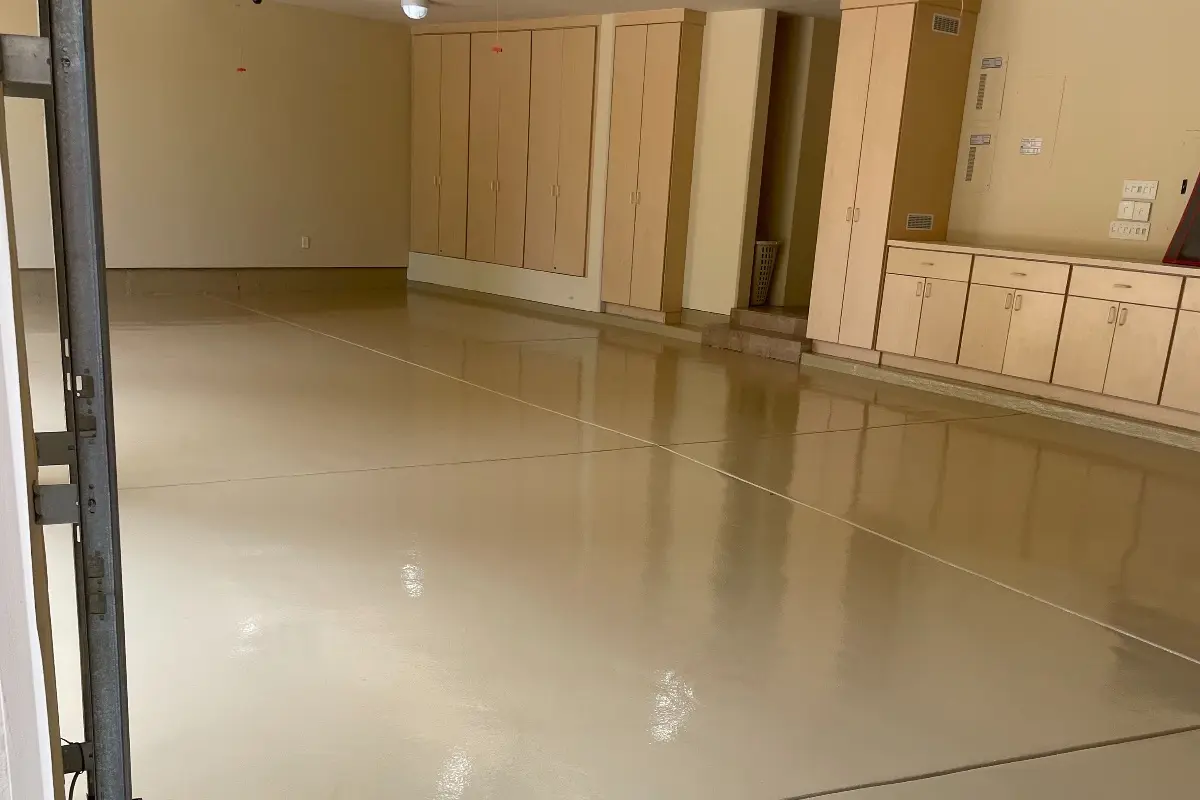
If you’re pricing out epoxy flooring in Las Vegas, the range you’ll see quoted is wide, usually $3 to $12 per square foot. That’s not a vague marketing number, it reflects real differences in materials, prep work, and the condition of your slab. This guide breaks down what actually drives that price so you know what you’re paying for before a contractor shows up.
What Counts as “Epoxy Flooring”
Epoxy flooring is a resin-based coating system applied over concrete. It bonds to the slab and cures into a hard, seamless surface that resists stains, abrasion, and chemical spills far better than bare concrete. In Las Vegas, it’s used in garages, warehouses, retail floors, and increasingly in patios and pool decks because it holds up to heavy use and cleans easily.
“Epoxy” gets used as a catch-all term, but most modern systems combine epoxy base coats with polyaspartic or polyurethane topcoats. The base coat does the bonding and buildup, the topcoat handles UV resistance and wear. Which combination you need depends heavily on where the floor sits and how much sun it gets.
Cost Breakdown by System Type
Basic 100% Solids Epoxy: $3-$7/sq ft
This is a single or double-coat epoxy system, sometimes with a broadcast of color chips for texture and hot tire pickup resistance. It’s a solid choice for garages that stay mostly closed or shaded. Without a UV-stable topcoat, straight epoxy will amber and dull over time if it sees direct sunlight, which matters in a market with 300+ sunny days a year.
Polyaspartic Systems: $5-$9/sq ft
Polyaspartic coatings cure faster than epoxy (often within a day instead of a week) and resist UV yellowing much better. In Las Vegas, where garage doors get left open and sun hits slabs directly, polyaspartic topcoats over an epoxy base are becoming the standard recommendation rather than the upgrade. For a full breakdown of how these two chemistries compare, see our polyaspartic vs. epoxy comparison.
Flake Systems: $6-$10/sq ft
Multi-color vinyl flake broadcast into a base coat, then sealed with a topcoat. Flake systems hide minor surface imperfections well and add slip resistance, which is useful on garage floors that see water, oil drips, or pool splash-off.
Metallic Epoxy: $8-$12/sq ft
Metallic pigments create a marbled, 3D look that’s popular for showroom garages, man caves, and retail spaces. It’s labor-intensive to apply correctly and the price reflects that skill requirement, not just materials.
Commercial-Grade Systems: $7-$12/sq ft and up
Warehouses, auto shops, and retail floors need higher film thickness, chemical resistance, and sometimes anti-slip additives. Commercial jobs also usually involve larger square footage, which changes the math on labor efficiency versus a single-car garage.
What Actually Drives Your Price
Surface Prep
This is the single biggest cost swing. Proper prep means mechanical diamond grinding or shot blasting to open the concrete’s pores so the coating can bond. Skipping this step, or using acid etching instead, is the number one reason epoxy floors fail early. Prep-heavy jobs (old slabs, previous coatings to remove, extensive cracks) cost more but they’re the difference between a floor that lasts 10+ years and one that peels in 18 months.
Moisture in the Slab
Las Vegas doesn’t have humidity problems like other regions, but slabs can still trap moisture from irrigation, grading issues, or a missing vapor barrier. A moisture test before coating isn’t optional on a job that’s going to hold up. If moisture is present, that adds cost for mitigation products or additional dry time.
Square Footage
Larger jobs get a lower per-square-foot rate because setup, equipment, and travel costs spread across more area. A 200 sq ft space will always cost more per foot than a 600 sq ft two-car garage.
Existing Floor Condition
Cracks, spalling, oil staining, and old paint or peeling epoxy all add labor. Repair work is typically priced separately or built into the prep phase.
DIY vs. Professional Installation
Box store epoxy kits run $50-$150 for enough material to cover a one-car garage, which sounds like a huge discount against professional pricing. The catch is what’s inside the kit and what it skips.
Retail kits are usually water-based epoxy with a thin film build, no real grinding step, and no polyaspartic topcoat. In a market with slab temperatures that can exceed 140°F in direct summer sun, thin DIY coatings are far more prone to hot tire pickup (tires lifting or marking the coating when a hot car parks on it) and peeling at the edges within a year or two.
Professional installation costs more upfront but includes mechanical prep, moisture testing, commercial-grade materials, and correct cure times between coats. Redoing a failed DIY floor almost always costs more than doing it right the first time, because failed coatings have to be fully removed before a new system goes down.
Why Las Vegas Heat and UV Change the Equation
Two climate factors push Las Vegas jobs toward higher-spec systems, which affects the price you should expect to pay.
Heat: Concrete slabs in direct sun regularly exceed 140°F in summer. Epoxy resists hot tire pickup better than paint or bare sealer, but the topcoat matters. Polyaspartic and polyurea topcoats handle heat cycling and rapid cure demands better than standard epoxy alone.
UV exposure: Unprotected epoxy yellows and chalks under sustained UV exposure. If your garage door stays open during the day, or you’re coating an outdoor patio or pool deck, a UV-stable polyaspartic topcoat isn’t cosmetic, it’s functional. Skipping it to save money on the front end often means a redo in a few years. Our guide to desert heat coatings for garage floors covers which systems actually hold up.
Common Mistakes That Cost More Later
Choosing a contractor based on the lowest bid without asking about prep method. Skipping a moisture test on an older slab. Picking a basic epoxy system for a garage that gets full sun exposure. Not asking whether the price includes crack repair or if that’s an add-on once work starts. Each of these tends to show up as a callback or a full redo within a few years, which costs more than paying for the right system once.
Why Hire a Pro
A professional crew brings the equipment (diamond grinders, shot blasters, moisture meters) that DIY kits and rental tools can’t match, along with the experience to read your slab’s specific problems before they become coating failures. In a climate that stresses coatings with heat and UV, getting the prep and topcoat selection right the first time is what makes a floor last. If you’re comparing bids, see our guide on how to choose an epoxy flooring company in Las Vegas before you sign anything.
FAQ
How much does epoxy flooring cost for an average Las Vegas garage?
A standard two-car garage (around 400-500 sq ft) typically runs somewhere between $1,500 and $5,000 depending on the system chosen and how much prep and repair work the slab needs. See our garage floor epoxy cost breakdown by size for a closer look at 1-car, 2-car, and 3-car pricing.
Is polyaspartic worth the extra cost over basic epoxy in Las Vegas?
For any floor that gets direct sun, yes. The UV stability and faster cure time reduce the chance of yellowing and shorten the time your garage is out of use during installation.
Can epoxy flooring handle Las Vegas summer heat without cracking or peeling?
Properly installed epoxy with a compatible topcoat handles slab heat well. Problems usually trace back to poor surface prep or a system not rated for the temperature swings, not the epoxy itself.
Does a moisture test really matter in a desert climate?
Yes. Even in a dry climate, slabs can hold moisture from irrigation nearby, poor grading, or missing vapor barriers. Coating over trapped moisture is a common cause of bubbling and delamination.
How long does an epoxy floor installation take?
Most residential garage jobs take one to three days depending on the system and number of coats, plus cure time before the floor can handle vehicle traffic.
Will a cheaper epoxy quote hold up as well as a pricier one?
Not usually. The price difference is almost always tied to prep quality and material grade. A lower quote that skips grinding or uses thinner coats tends to fail sooner, costing more in the long run.
Ready to get a real number for your space? Contact Reveles Concrete for a free estimate on epoxy flooring built for Las Vegas heat and sun.