

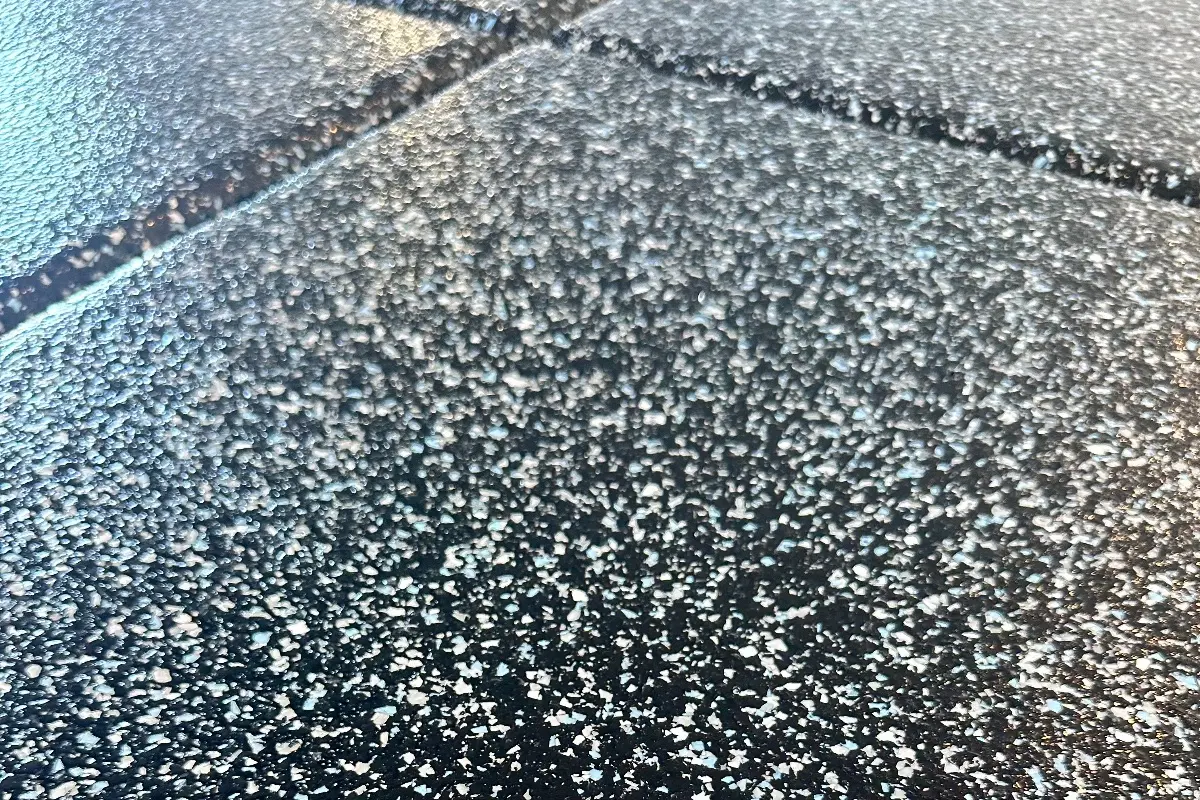
If you’re comparing garage floor coatings in Las Vegas, you’ve probably noticed most quotes push flake epoxy over a solid color finish. There’s a reason for that. Flake epoxy holds up better against tire tracking, hides everyday grime, and gives you a floor with actual traction instead of a slick painted surface. Here’s what it is, how it’s installed, and why it makes sense for a desert garage.
What Flake Epoxy Actually Is
Flake epoxy is a multi-layer system, not a single coat of paint. A contractor preps the slab, applies a pigmented epoxy base coat while it’s still wet or tacky, then broadcasts vinyl color chips (the “flakes”) across the surface by hand or with a hopper gun. Once the base cures, the excess flake gets scraped and vacuumed off, and the whole floor gets sealed with one or two topcoats, usually a clear polyaspartic or epoxy.
That flake layer isn’t decorative filler. It’s sandwiched between the base coat and the topcoat, which means it’s locked in and protected from foot traffic, tires, and dropped tools. You’re not walking on loose chips, you’re walking on a smooth, sealed surface with flakes embedded underneath the clear coat.
Color and Blend Options
Flake blends come pre-mixed from manufacturers in dozens of combinations, and this is where most homeowners spend their decision-making time. Common categories include:
- Neutral/gray blends – grays, whites, and charcoal flakes that match almost any house exterior and don’t show dust as fast
- Earth tone blends – tans, browns, and rust tones that fit desert landscaping and stucco color palettes common in Las Vegas subdivisions
- Bold accent blends – blacks and whites with a pop color (blue, red, green) for garages used as a workshop or show space
- Monochrome/single-color flake – for a cleaner, more uniform look with less visual noise
You can also control flake density. A “full broadcast” covers the base coat completely for maximum coverage and durability. A lighter broadcast lets more of the base color show through for a more subtle, speckled look. Most Vegas garages go with full broadcast because it hides more and wears more evenly over time.
Why Texture Matters in a Desert Garage
This is the practical reason flake wins over solid color epoxy in this market, and it’s not about looks.
Slip Resistance
Flake creates a textured, slightly irregular surface. Solid color epoxy, especially when it’s wet from a car dripping water, sweat, or a hose, can get slippery fast. The flake texture (especially combined with an anti-slip additive broadcast into the final topcoat) gives you real grip. That matters if your garage doubles as a gym, workshop, or the entry point for kids and pets tracking in from the pool.
Hiding Dust, Debris, and Tire Marks
Las Vegas garages deal with fine dust that blows in every time the door opens, plus dirt bike tires, work boots, and the occasional oil drip. A solid color floor, especially dark solid colors, shows every bit of that. It scratches visibly and shows tire marks as faint streaking over time. A multi-color flake blend breaks up the surface visually, so dust, small scuffs, and light tire marks blend into the pattern instead of standing out. Homeowners who’ve had solid color floors elsewhere in dusty climates often switch to flake specifically for this reason.
Heat and UV Inside the Garage
Garage interiors in Las Vegas summers routinely climb well above ambient outdoor temperature, especially with a west-facing garage door taking direct sun for hours. Quality epoxy and the topcoats used over flake systems are formulated to handle interior heat exposure without softening or discoloring the way a cheap DIY kit might. This is a garage floor, not a pool deck, so UV exposure is far more limited than an uncovered patio, but heat resistance still matters for a coating that sees closed-door temperatures for months at a time.
Durability: Why the Flake and Topcoat Combination Holds Up
The flake itself is a vinyl chip, tough and colorfast on its own, but the real durability comes from the sandwich structure:
- Base coat bonds to the properly prepped and profiled concrete
- Flake layer adds texture and visual depth, locked in place
- Topcoat (clear epoxy or polyaspartic) seals everything, resists abrasion, chemicals, and hot tire pickup
Hot tire pickup, where a warm tire lifts or marks a soft coating as a car sits overnight, is a real concern in Las Vegas heat. A properly cured, quality topcoat over a flake system resists this far better than thin, single-coat DIY products. This is also why proper cure time matters. Rushing a job and parking a car too soon is one of the most common reasons a garage coating fails early, in any climate.
Cost: What to Expect
Flake epoxy garage floors typically run in the $5 to $8 per square foot range, depending on square footage, existing slab condition, how much crack or moisture repair is needed, and flake density. That range generally covers:
- Mechanical surface prep (diamond grinding, not just an acid etch)
- Pigmented epoxy base coat
- Full or partial flake broadcast
- Clear topcoat (epoxy or polyaspartic)
Larger garages typically land toward the lower end per square foot, and floors needing significant crack repair, oil stain removal, or moisture mitigation will land higher. Get an on-site estimate rather than a phone quote. Slab condition varies enough between homes that a flat number without seeing the floor isn’t reliable. See our garage floor epoxy cost breakdown by size for more detail.
How Flake Compares to Solid Color and Metallic Epoxy
Solid color epoxy is the budget option. It’s a straightforward pigmented coat with a clear topcoat, no flake layer. It looks clean when new but shows wear, dust, and tire marks faster, and offers less texture for traction. It’s a reasonable choice for a garage that sees light use and gets cleaned often.
Metallic epoxy uses metallic pigments manipulated with tools and air to create a marbled, three-dimensional look. It’s the premium, showpiece option, often chosen for a floor meant to be seen (an enthusiast’s garage, a converted living space) rather than one that just needs to perform. It costs more than flake and requires more installer skill to execute well. See our metallic epoxy design options guide for colors and pricing.
Flake epoxy sits in the middle: better hiding power and traction than solid color, less cost and complexity than metallic, and it’s the most common choice for a daily-use family garage in this climate.
FAQ
How long does a flake epoxy garage floor last in Las Vegas heat?
With proper installation, mechanical concrete prep, and a quality topcoat, a flake epoxy floor can last well over a decade of normal residential use. The biggest factors are slab prep quality and avoiding heavy point loads (jack stands, motorcycle kickstands) without protective pads. See how long epoxy lasts in the desert for lifespan by system type.
Can flake epoxy handle hot tire pickup from a car sitting in a 115°F garage?
Yes, when the system uses a durable topcoat like polyaspartic or a high-quality epoxy formulated for hot tire resistance. Cheap, thin DIY coatings are the ones that lift or mark under hot tires, not properly installed flake systems.
Do I need to close my garage door during and after installation?
During application and cure, yes, dust and debris need to stay out and the coating needs to cure undisturbed. Cure times vary by product, but plan on keeping vehicles off the floor for at least 24 to 72 hours and avoiding heavy use for a week, depending on the specific system used.
Will flake epoxy crack if my slab has existing cracks?
Hairline cracks are typically routed and filled during prep, and the coating goes over the repair. If a crack is actively moving (from foundation settling, for example), it needs to be evaluated separately, since no coating will permanently bridge a structural movement crack without it eventually showing through.
Is flake epoxy slippery when my car drips water or sweats condensation?
It’s significantly less slippery than solid color epoxy because of the raised texture from the flake, and adding a fine anti-slip additive to the topcoat improves grip further. No garage floor is completely slip-proof, but flake systems perform noticeably better than smooth painted floors.
Can I pick a custom flake blend or do I have to choose from a set list?
Most installers work from manufacturer color card systems with a wide range of premixed blends. Fully custom, hand-mixed blends are possible with some installers but usually cost more and take longer to source. Bring inspiration photos to your estimate and your installer can usually match you to the closest standard blend or discuss custom options.
Get a Free Estimate
If you’re ready to stop looking at a cracked, stained, or bare concrete garage floor, Reveles Concrete can walk your slab, explain what prep it actually needs, and give you a real number for a flake epoxy system built for Las Vegas conditions. Request a free estimate today and get a floor that handles the heat, the dust, and daily use without falling apart in a year or two.