

Garage Floor Coatings in Las Vegas
Reveles installs polyaspartic and epoxy garage floor coatings across Las Vegas, Henderson, Summerlin and the surrounding valley. Garage is the most requested coating we do here and it is also the one with the most ways to go wrong, because a Las Vegas garage is one of the harshest environments a floor coating is asked to survive.
What a Las Vegas garage does to a floor
Three things, and all three are about heat.
Slab temperature. An uninsulated garage in this valley runs far hotter than the air outside it, and the slab holds that heat long after sunset. A coating that cures and performs fine in a mild climate softens, marks and fails here. This is the single reason most cheap garage coatings in Las Vegas do not make it through a second summer.
Hot tire pickup. A car driven in summer returns with tires hot enough to soften an inadequate coating on contact. The tire then grips it, and when the car moves the coating lifts with the tire. It appears as patches pulled up exactly where the wheels sit, and it is the most common garage coating failure we are called to repair. It is entirely a product and preparation problem, not a maintenance problem.
UV at the door line. The first few feet inside an open overhead door take direct desert sun. Epoxy is not UV stable and ambers there, so a garage finished entirely in epoxy develops a visible yellow strip across the threshold within a year or two while the rest of the floor stays true.

Polyaspartic is the answer here, and not for the usual reason
Polyaspartic is normally sold on cure speed. In this climate the reason that matters is different: it stays flexible across a far wider temperature range than epoxy, it is UV stable so it does not amber at the door, and crucially it resists hot tire pickup where a rigid epoxy topcoat does not.
What we install on most Las Vegas garages is a system rather than a single product: a moisture-mitigating primer where testing calls for one, an epoxy or polyaspartic base coat for bond and build, a broadcast flake layer, and a polyaspartic topcoat. The topcoat is where the heat resistance lives, so that is where it is specified without compromise.
Straight epoxy garages are cheaper and we will install one if that is what you want, but we will tell you first what it will look like at the door line in two summers.
Flake is not just appearance
Broadcast flake does four jobs in a garage: it hides slab imperfections, it provides slip resistance once topcoated, it disguises dust and tire marks between cleanings, and it gives a surface that still looks right after years of use.
The dust point matters more here than in most places. This is a desert valley and fine dust gets into a garage no matter what you do. A solid color garage floor shows every bit of it. A flake floor does not, and that is why nearly every garage we finish is flake.
We have written on why flake hides dust and tire marks better than most finishes.
- Hides slab imperfections
- Adds slip resistance once topcoated
- Disguises dust and tire marks between cleanings
- Still looks right after years of use
Preparation decides whether any of it lasts
Every garage coating failure we repair traces back to preparation.
We have written on the polyaspartic mistakes that cause peeling, bubbles and dull spots, which is almost entirely a preparation list.
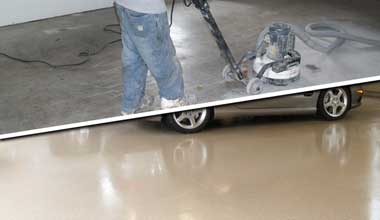
Mechanical profile
The slab is diamond ground or shot blasted so the coating keys into it. Acid etching does not produce a reliable profile and we do not use it. A coating on a sealed, troweled slab sits on the surface and comes off in sheets, usually with the first hot tire.

Moisture testing
Concrete pushes vapor upward and a slab with no vapor barrier beneath it pushes more. If that drive exceeds what the coating tolerates, it blisters and delaminates months later for reasons that look mysterious. We test before we coat.
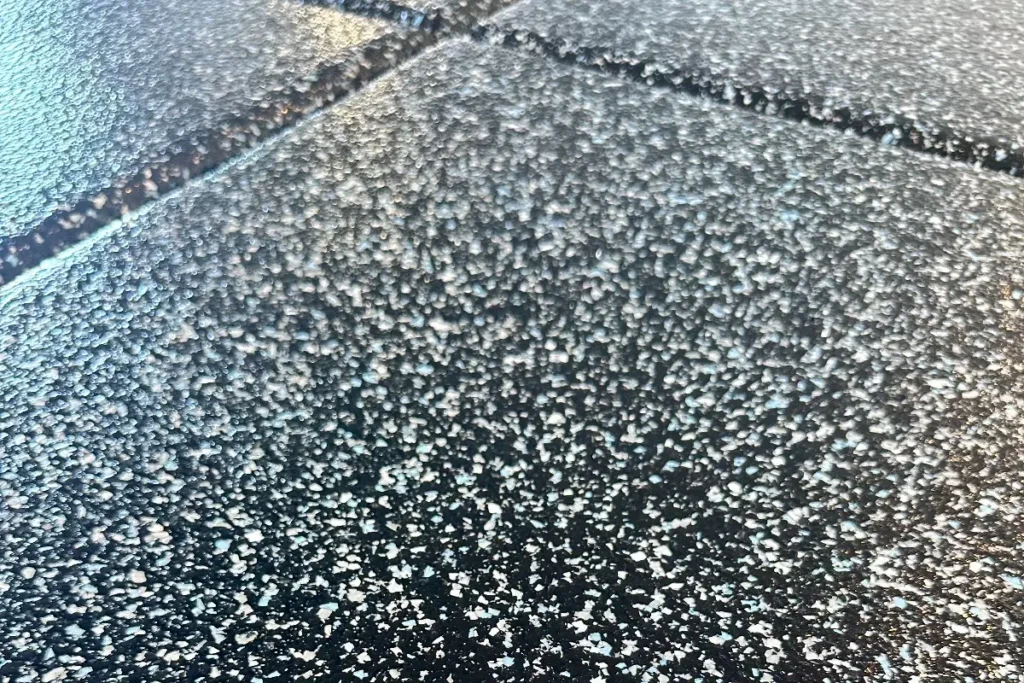
Crack and joint treatment
Cracks are chased, filled with a semi-rigid filler and ground flush. Control joints are honored or filled depending on whether they are still moving. A crack coated over telegraphs through within a season.
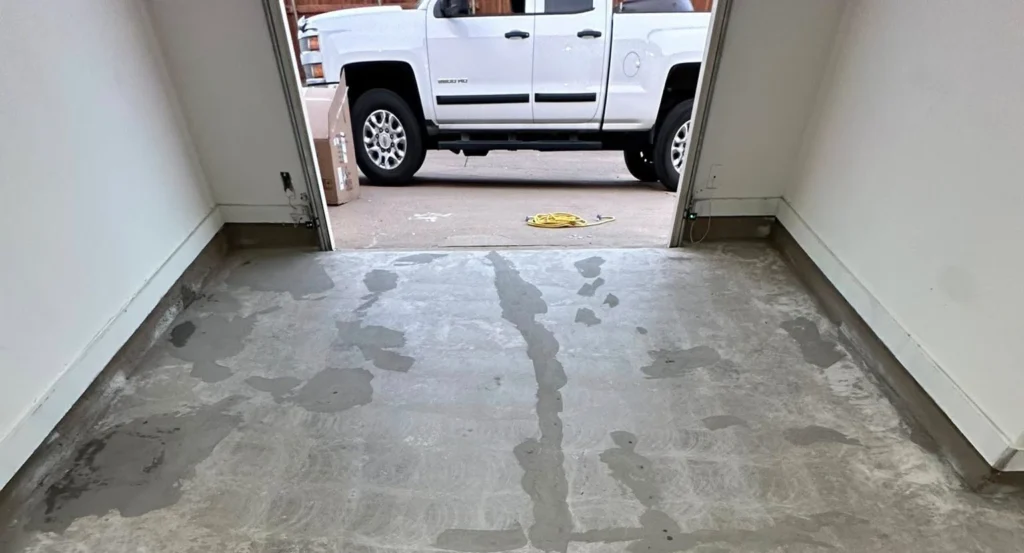
Oil removal
Oil that has soaked into a garage slab comes out before coating rather than being covered. On a slab with years of drips this means degreasing and sometimes localized grinding deeper than the general profile.
Installation and getting your garage back
A standard residential garage is usually a one-day install once preparation is complete: grind, treat cracks, prime where needed, base coat, broadcast flake to rejection, scrape and vacuum the excess, then topcoat.
With a polyaspartic topcoat you are normally walking on it the same evening and parking on it the next day. That is the practical argument for the system in a house where the garage is the only way in.
Summer scheduling is its own consideration. Slab temperature affects cure, and there are days in July and August when the right answer is to start early or to schedule differently rather than to push through. A contractor who will coat any slab at any temperature is not managing the cure.
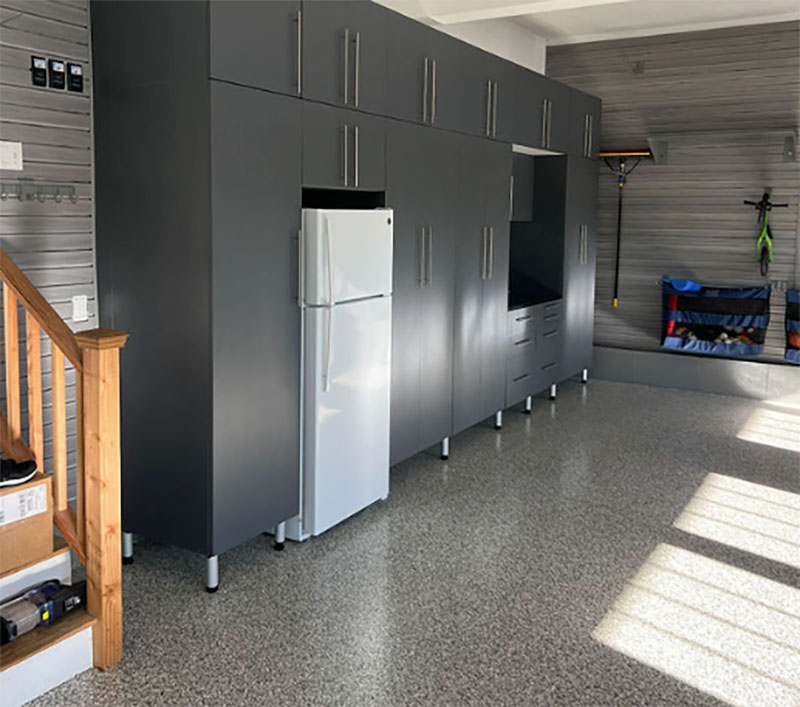
What moves the price
Not square footage, mostly. What decides it is the condition of the slab: how much crack and joint repair it needs, whether moisture testing calls for a mitigating primer, whether oil contamination requires deeper localized grinding, whether an existing coating or sealer has to come off first, and which system you choose.
An honest quote names those as separate lines so you can see what changes if the slab turns out worse than it looks. See our Las Vegas epoxy flooring cost guide for what drives the number, and garage floor epoxy cost in Las Vegas for the garage-specific version.
Beyond the garage
The same systems, specified differently, cover driveways, patios and pool decks, where UV and surface temperature matter even more than they do inside a garage. For a heavier decorative system see Graniflex coatings, and for commercial and industrial floors see commercial and industrial flooring.
Get a quote on your garage
Every quote starts with looking at the slab, because the slab decides the job. Get in touch and we will come and look at it.