

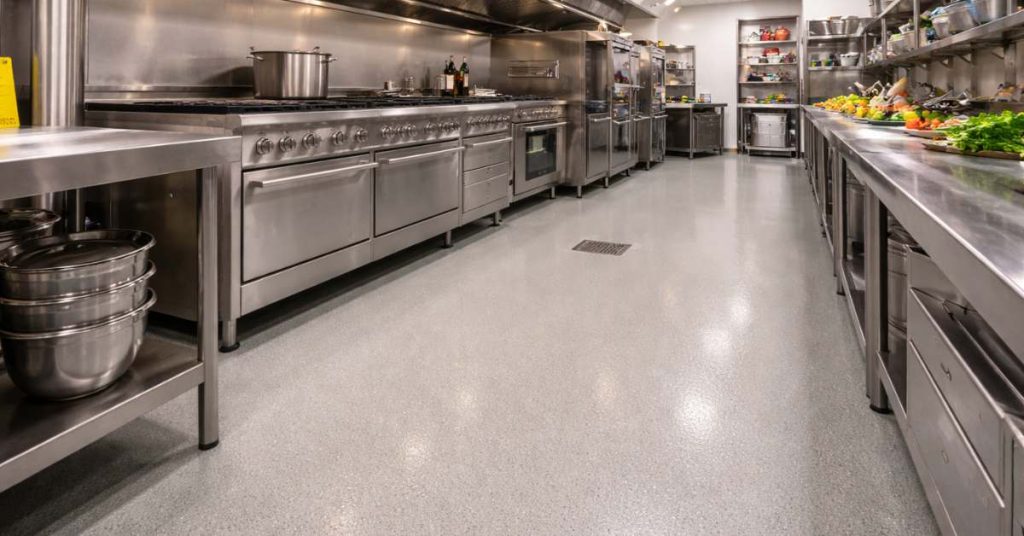
Food grade epoxy flooring can be a strong fit for commercial kitchens because it creates a seamless, cleanable surface—but the “right choice” depends on traction, washdown habits, heat exposure, and how the kitchen handles grease day to day.
Commercial kitchens are one of the toughest environments for any floor. Grease films build up even when the space looks clean. Water is constant, whether from mopping, rinsing, or spills. Food acids and dyes show up daily. And the traffic is not gentle: staff move quickly, carts roll across thresholds, heavy items get dropped, and cleaning schedules are often aggressive.
That combination is why many operators consider food grade epoxy flooring. The appeal is straightforward: a seamless, non-porous surface that can tolerate frequent cleaning and helps remove hiding places for grime. However, “food grade” is often misunderstood. It is not a magic label that automatically guarantees slip resistance, perfect durability, or zero maintenance. The system still has to be selected for the reality of a working kitchen.
This article breaks down where food grade epoxy flooring tends to perform well in commercial kitchens, where it can disappoint when the system is mismatched, and the practical details that determine long-term results.
What operators usually mean by “food grade” in flooring
In everyday conversation, “food grade epoxy flooring” typically means a floor system that supports a hygienic environment by offering:
- A seamless surface that is easier to clean than grout-based flooring
- A non-porous finish that reduces absorption of liquids, oils, and food dyes
- Resistance to common kitchen chemicals, including many cleaners and degreasers
- The ability to integrate hygienic details like cove bases (where the floor meets the wall)
The intent is to reduce the places where soils build up and to make cleaning routines more effective. That’s the operational value: it can help a kitchen stay cleaner with less guesswork, especially compared to porous concrete, worn grout, or flooring with failing seams.
Why commercial kitchens are uniquely hard on epoxy systems
A commercial kitchen does not stress a floor in one way; it stresses it in several ways at the same time.
Grease films that reduce traction and bond strength (if present during install)
Grease is the biggest wildcard. It matters in two separate phases:
- During installation: embedded grease in the slab or in old coatings can undermine adhesion. If contaminants remain, a coating may bond unevenly and wear faster in patches.
- During operations: grease can form a thin film on top of the floor, which changes traction and makes a surface feel slippery even if it was designed with grip.
A kitchen can have great slip resistance in theory and still be slick in real life if grease films are allowed to accumulate or if cleaning leaves residue.
Daily wet conditions
Between dish areas, prep sinks, mop buckets, and occasional spill events, kitchens frequently have wet floors. That has two implications:
- The floor should be designed for wet traction, not just dry traction.
- The system should handle repeated wet/dry cycling without degrading or becoming cloudy in stressed areas.
Heat, thermal shock, and hot equipment zones
Cooking lines, ovens, and areas near steam can introduce heat stress. While epoxy systems are generally durable, thermal exposure can accelerate wear in localized zones, especially if hot water is used for cleaning and rapidly cools the slab afterward.
Aggressive cleaning routines
Commercial kitchens often use strong degreasers and sanitizers. Over time, harsh chemistry combined with abrasion from scrubbing can:
- Dull the finish
- Wear down the wear layer faster
- Change traction if the surface becomes “polished” by cleaning
The flooring system should be selected with the actual cleaning regimen in mind, not an idealized version of it.
Where food grade epoxy flooring is usually a good fit in commercial kitchens
Food grade epoxy flooring tends to make the most sense in kitchens where the operator values cleanability, seamlessness, and a consistent surface across multiple zones.
Common strong-fit areas include:
- Prep areas where spills and food dyes are common
- Walkways and service corridors where staff movement is constant
- Dish areas (when the system is designed for wet conditions)
- Storage areas where dust control and easy cleaning matter
- Back-of-house transitions where grout lines and seams typically fail first
It can also be a practical fit when a kitchen wants to reduce grout maintenance and replace aging tile floors that are hard to keep looking clean.
Where food grade epoxy flooring can be the wrong choice (or needs extra planning)
Epoxy can underperform when the floor is built without accounting for the kitchen’s “real” conditions.
Kitchens with constant standing water and poor drainage
If water routinely sits on the floor, the issue is not only the coating. It is also how the space manages water. Any floor will struggle when water is constantly pooled in corners and along wall lines.
In these kitchens, the key question becomes:
- Is the space designed for washdowns and drainage, or is it being cleaned as if it were?
If the kitchen truly needs washdown behavior, detailing and water management become as important as the coating itself.
Spaces that need extreme impact resistance
Dropped cookware, heavy rolling equipment, and metal edges can chip any hard floor surface if impacts are severe enough. If impacts are frequent and heavy, the floor system should be chosen and built with that abuse in mind, and protection strategies for extreme zones may be necessary.
Facilities with contaminated or previously coated slabs
Older kitchen slabs are often contaminated with oils, waxes, or old sealers. Installing a new epoxy system over a slab with hidden contamination is a common cause of premature failure.
If the floor has a history of coatings, adhesives, or grease saturation, the success of epoxy depends heavily on proper removal and profiling, not just the new product.
The biggest decision in commercial kitchens: traction level
Slip resistance is a primary decision in any commercial kitchen. The challenge is that traction and cleanability trade off against each other.
Too smooth
- Easier to mop
- Can become slick when wet or when a grease film forms
- Higher slip risk in dish and cooking zones
Too aggressive
- Better wet traction
- Can trap grime and make cleaning more labor-intensive
- Can wear unevenly in high-traffic paths if the surface is overly textured
The practical target for many commercial kitchens is controlled texture: enough grip for wet conditions, without creating a surface that constantly holds soils.
Traction choices should also match footwear realities. Kitchens often rely on slip-resistant shoes, but flooring should not assume perfect footwear compliance.
How grease and cleaning chemistry affect “food grade” performance
The floor’s day-to-day performance often comes down to what happens after installation: grease management and cleaner selection.
Grease films and “false slippery” floors
A floor may be textured and still feel slick if grease accumulates and is not fully removed. This can happen when:
- Degreasers are too mild for the grease load
- Dwell time is too short
- Floors are “cleaned” but not thoroughly rinsed
- Cleaning leaves a residue layer
Residue is a common issue. Some cleaners and sanitizers can leave a film if not used and rinsed correctly. That film can reduce traction and attract more soils.
Abrasion from cleaning equipment
Auto-scrubbers, stiff brushes, and repeated heavy scrubbing can wear down the top surface. Over time, the floor may:
- Lose sheen (not necessarily a problem)
- Show traffic lanes (cosmetic)
- Become smoother in high-use areas (traction change)
The key is balancing cleaning intensity with a system that can tolerate it.
Installation realities that determine whether epoxy is “right”
Even the best system choice will underperform if the install variables are wrong for a kitchen environment.
Surface preparation and contamination removal
Kitchens demand more stringent prep because grease can be embedded below the surface. Proper prep usually requires:
- Deep cleaning and degreasing methods that actually remove contaminants
- Mechanical profiling so the epoxy can bond properly
- Attention to cracks and joints that move or hold soils
Edge details and wall transitions
Where floors meet walls is a common hygiene weak point. Many kitchens prefer a coved transition because it removes a hard 90-degree corner where grime collects. Even if a full cove is not used, the detail at the wall line should be deliberate, not an afterthought.
Scheduling and cure time
Commercial kitchens cannot stay offline for long. Fast return-to-service requirements can drive system selection and installation phasing. The floor choice should reflect the facility’s downtime tolerance.
A practical decision checklist for operators
Food grade epoxy flooring tends to be the right choice for a commercial kitchen when most of the following are true:
- You want a seamless surface that is easier to clean than tile and grout
- The kitchen can support proper prep and installation (including contamination removal)
- You can choose a finish with controlled wet traction
- Your cleaning routine can remove grease without leaving residue
- Drainage and water management are reasonable for the level of wet cleaning being done
If several of these are not true—especially if drainage is poor and water stands daily—then the flooring decision should be made alongside operational changes, not in isolation.
Food grade epoxy flooring can be a strong choice for commercial kitchens because it supports hygiene through a seamless, non-porous, cleanable surface. The “right choice,” however, depends on matching the system to the kitchen’s real stressors: grease films, daily wet conditions, heat zones, and aggressive cleaning.
When traction is selected responsibly, contamination is removed during prep, and cleaning practices avoid residue buildup, epoxy can deliver practical performance that fits the day-to-day demands of a working kitchen. The best outcomes come from treating the floor as an operational surface—designed around workflow, cleaning habits, and the wet, greasy reality of commercial food environments.