

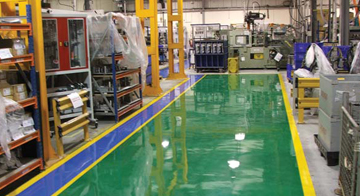
Epoxy flooring for warehouses is less about a “one-product solution” and more about matching the coating system to rolling loads, turning stress, and the specific zones where warehouses punish concrete the most.
Warehouses are hard on floors in predictable ways. Forklifts compress wheels into the surface and grind grit into the slab. Pallet jacks create repeated point loading and scrubbing in the same travel lanes. Staging areas see constant turning, which is one of the fastest ways to wear down a coating. Racking zones introduce concentrated static loads and impact risk from dropped pallets.
That is why selecting epoxy flooring for warehouses should start with a practical question: what does the facility do to the floor every day? Once you know the wear points, you can choose a system build that makes sense for those demands rather than relying on a generic “industrial epoxy” label.
What warehouses do to concrete that other spaces do not
Compared to offices, retail, and many light commercial spaces, warehouses add three stress categories that change system selection.
Rolling load abrasion and turning lanes
Aisles and staging lanes behave like “abrasion tracks.” Even if the slab is structurally sound, grit under wheels acts like sandpaper. Turning movements near dock doors, intersections, and staging zones create the highest wear because wheels scrub instead of rolling straight.
Point loads and impacts
Pallet jacks, pallet drops, and occasional metal-to-concrete impacts can chip weaker surfaces. A coating that looks fine under foot traffic can break down quickly under repeated point loading.
Dusting and maintenance realities
Warehouses are often cleaned with auto scrubbers or aggressive sweeping schedules. That’s helpful, but it also means the surface is continually being contacted by pads and bristles. A system has to tolerate frequent cleaning without glazing over or wearing thin in traffic lanes.
A warehouse “zone approach” to choosing an epoxy system
Most warehouses are not one uniform environment. Floors should be evaluated by zones:
- Dock and staging areas: highest turning stress and impact risk
- Main aisles: high rolling load, grit abrasion
- Pick/pack zones: foot traffic plus cart traffic and repeated movement
- Racking areas: heavy static loads, occasional pallet impact
- Battery charging or chemical exposure zones (if applicable): chemical resistance becomes a primary driver
A zone approach helps avoid overbuilding low-stress areas or underbuilding the zones that fail first.
System types commonly used for epoxy flooring for warehouses
“Epoxy flooring” can describe multiple system builds. Warehouses typically require a build that prioritizes bond strength, thickness, and a wear layer that handles abrasion.
Multi-coat epoxy system (broadcast or build coat + protective topcoat)
This is a common warehouse approach when the goal is a seamless, durable floor that improves cleanability and reduces dusting.
Where it fits:
- General warehousing with forklifts and pallet jacks
- Facilities that want a consistent, easy-to-clean surface
Why it works:
- Multiple coats add thickness and durability
- A protective topcoat can be selected for wear and chemical needs
- Optional broadcast media can add texture and hide minor imperfections
Main consideration:
- The surface profile and coating thickness need to match rolling load intensity. Thin systems wear through quickly in turning zones.
Heavy-build epoxy (thicker build for higher stress lanes)
When turning lanes and high traffic are severe, heavier build systems are often used to increase wear life before the slab is exposed again.
Where it fits:
- Forklift-heavy warehouses
- Staging areas and intersections with constant turning
Why it works:
- More material in the wear layer means more time before abrasion reaches the substrate
Main consideration:
- More thickness does not fix poor prep. Bond quality is still the foundation.
Epoxy mortar or troweled systems (for extreme abuse areas)
These are used when impact, point loading, and damage potential are high. They are not necessary for every warehouse, but they are a fit for demanding zones.
Where it fits:
- Areas with frequent pallet drops or heavy mechanical activity
- Repair zones where the slab is already damaged and needs rebuild
Why it works:
- Very high compressive strength and thickness
- Better resistance to impact and mechanical abuse than thin film systems
Main consideration:
- Higher cost and more intensive installation; often applied selectively in high-abuse zones.
Key performance factors for forklifts and pallet jacks
If the warehouse uses forklifts and pallet jacks daily, the following variables are what usually determine success or premature wear.
Abrasion resistance in travel lanes
Travel lanes will dull and wear first. A suitable system should be designed so the wear happens gradually and predictably rather than failing in patches.
Practical indicators of high wear zones:
- Tight turns at the dock
- Aisle intersections
- Pick/pack routes
- Areas where forklifts stop and pivot
Compressive strength and point load tolerance
Pallet jack wheels and loaded pallets concentrate force into small contact areas. A coating should tolerate that without chipping or crushing at the surface, especially near joints and repaired sections.
Traction that matches the environment
Warehouses often need controlled traction, not maximum texture:
- Too smooth can be risky in wet or dusty conditions.
- Too aggressive can trap dirt and make scrubber cleaning less effective.
Traction decisions should reflect:
- Whether the facility gets wet (washdowns, weather intrusion)
- How often dust accumulates
- The type of cleaning equipment used
Racking areas: the overlooked stress zone
Racking adds static load, but the bigger issue is what happens during operations:
- Pallets slide and bump the floor
- Forks can strike the slab during placement
- Loads may shift and drop corners
In racking areas, the floor benefits from:
- Strong bond and proper prep (to resist chipping at edges)
- Thoughtful joint repair and load transfer decisions
- A system with enough build to tolerate repeated small impacts
If joints are deteriorated in racking zones, coating over them without repair often leads to early edge chipping and spalling that spreads.
Why concrete prep matters more in warehouses than almost anywhere
For epoxy flooring for warehouses, prep is not a formality; it is the make-or-break step.
Warehouses commonly have:
- Oil contamination in old traffic lanes
- Hard-troweled surfaces that are too smooth for bond
- Dusting concrete that needs removal of weak surface paste
- Existing coatings that must be removed or properly profiled
- Joint movement and cracks that require a plan
If the surface is not properly opened and cleaned, epoxy may bond initially but fail under rolling loads, especially in turning zones.
Operational realities that should guide system selection
A warehouse floor is not selected in a vacuum. The system choice should align with how the facility operates.
Downtime and install phasing
Many warehouses cannot shut down fully. That often pushes projects into:
- Phased installs (zones or aisles at a time)
- Off-hours work
- Rapid return-to-service requirements
Those operational constraints can influence which build makes sense, especially if the space needs to return to traffic quickly.
Cleaning equipment and routines
Auto scrubbers and sweepers are common. The system should be compatible with:
- Routine scrubbing without excessive dulling
- Detergents that do not leave residue
- Dust control goals
A floor that is too textured may require more aggressive scrubbing to keep it clean, which can increase wear over time.
Marking needs
Many warehouses use floor markings for:
- Pedestrian lanes
- Equipment paths
- Staging zones
- Safety boundaries
A coating system can provide a cleaner base for markings and help them last longer than paint directly on porous concrete, but the marking plan should be accounted for in the system design.
What “good” looks like after installation
A successful warehouse epoxy system is not just shiny. It should deliver practical performance:
- A seamless surface that reduces concrete dusting
- Predictable wear in lanes rather than random peeling
- Traction that suits cleaning methods and working conditions
- A surface that is easier to maintain than bare concrete
- Protection in the highest-abuse zones (dock/staging/turning areas)
The most common sign of a mismatch is rapid wear in turning lanes within a short period, often tied to thin build, wrong wear layer, or weak prep.
Epoxy flooring for warehouses performs best when the system is chosen based on real warehouse stress: forklift traffic, pallet jack point loads, racking impacts, and abrasion in turning lanes. A zone-based approach—dock and staging versus aisles versus racking—helps match build thickness and wear-layer decisions to where the floor actually gets punished.
When surface preparation is correct and the system is built for rolling loads, epoxy can improve dust control, cleanability, and long-term floor durability across warehouse environments without relying on generic “industrial” labels.
Meta title: Epoxy Flooring for Warehouses: System Guide for Forklifts
Meta description: Learn how to choose epoxy flooring for warehouses based on forklift traffic, pallet jacks, turning lanes, and racking zones. Understand system types, wear factors, and why prep drives long-term results.