

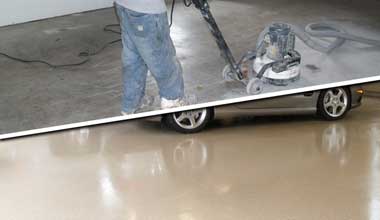
A practical breakdown of what you’re actually paying for, and why two garages with the same square footage can price out very differently
When homeowners search epoxy garage flooring cost, they’re usually hoping for a clean price tag they can plug into a budget. The problem is that garage floors aren’t priced like a packaged product. They’re priced like a surface-built system, where most of the cost is driven by prep work, slab condition, and how the coating is built.
Two garages can be the same size and still land in very different price ranges because the concrete underneath may be completely different. One slab is clean, flat, and ready. The other has oil saturation, old paint, cracks, moisture behavior, or a failing DIY coating that has to be removed correctly before anything new can bond.
This guide explains the main cost drivers behind epoxy garage floors in Las Vegas homes, what typically increases or decreases price, and what “cheap vs expensive” often reflects in real installation terms—without turning into a sales pitch or throwing out unrealistic numbers.
Why epoxy garage flooring cost isn’t a simple per-square-foot quote
You’ll see per-square-foot pricing discussed online, and it can be useful for rough planning. But it’s incomplete because it assumes the floor is “standard.” In reality, epoxy garage flooring cost usually comes from a mix of:
- Labor and equipment time (especially concrete prep)
- Materials (base coat, flakes if used, topcoat, repair materials)
- Site conditions (ventilation, access, temperature, complexity)
- Risk variables (old coatings, moisture concerns, slab defects)
The coating is visible, but the cost is often dominated by what happens before the first coat is applied.
Cost driver #1: Square footage and layout complexity
Square footage matters, but not in a straight-line way.
- A larger garage has more material and more labor time.
- But larger spaces can sometimes be more efficient per square foot because setup time gets spread out.
Layout complexity can push cost up even when square footage is modest. Examples include:
- Tight corners and short runs that require more hand detail work
- Two-car garages full of built-ins, water heaters, or obstacles
- Stem walls, steps, or uneven transitions
- Additional rooms connected to the garage (storage rooms, side bays)
The more “cutting in” and detail work required, the more time the install takes.
Cost driver #2: Concrete condition and how much repair work is needed
Concrete condition is one of the biggest reasons prices vary.
Common issues that can increase cost
- Cracks that need proper repair and leveling
- Spalling or pitting that must be patched for a smooth finish
- Settled areas or uneven patches from older repairs
- Weak surface layer (soft top paste that must be removed during prep)
Some homeowners expect coatings to “hide” flaws. In reality, coatings usually highlight flaws if the slab isn’t corrected first, because the finished surface reflects what’s underneath.
Cracks: appearance vs movement
Crack repair can be priced differently depending on what’s required:
- Cosmetic filling for dormant cracks
- More involved repair for wider cracks
- Addressing joint edges or spalled transitions
Even with good repair, it’s normal for some slab movement to show over time in certain conditions. That doesn’t mean the coating failed—it means the concrete is still concrete.
Cost driver #3: Surface preparation and grinding time
Prep is where most of the real work is. The purpose of prep is to create a clean, textured concrete surface that the system can bond to.
In garages, prep commonly involves mechanical profiling (often grinding). Cost increases when:
- The slab has heavy contamination (oil, grease, tire plasticizers)
- The surface is harder than average and takes longer to cut
- The garage has tight edges that require more hand grinding
- There are multiple surface conditions across the same slab (smooth here, rough there)
Why “just acid wash it” isn’t the same
Some cheaper installs rely on minimal prep. The issue is that epoxy is a bond-dependent system. If the slab isn’t properly prepared, the coating can be more vulnerable in the places garages stress the most:
- Parking zones
- Turning zones
- Door threshold
- Hot-tire areas
A big part of epoxy garage flooring cost is paying for prep that gives the system a dependable base.
Cost driver #4: Old paint, sealers, or previous coatings that must be removed
Removal work can change the scope of the job quickly.
Garages often have:
- Old paint (sometimes multiple layers)
- A clear sealer that causes water to bead on the slab
- Failed DIY epoxy kits
- Patchy coatings that peeled in some areas and stuck in others
Removing old coatings is rarely “one pass.” It can require:
- More aggressive grinding
- Extra passes to reach clean, consistent concrete
- Edge detailing where coatings collect
- Additional cleanup so dust and residue don’t interfere with adhesion
This is one of the most common reasons two same-size garages get different quotes.
Cost driver #5: Moisture behavior and slab location
Moisture is a cost driver because it influences system selection and prep decisions. Even in Las Vegas, slabs can transmit moisture vapor depending on:
- How the slab was built
- Drainage and irrigation patterns
- Past water intrusion
- Perimeter conditions near stem walls
- Seasonal changes and microclimates in the home
Moisture concerns can lead to additional steps to reduce risk. When the slab shows signs that moisture could be a factor, installers may need a more specific approach than a standard one.
Cost driver #6: System build and number of layers
An epoxy garage floor is usually not “one coat.” Systems are built in layers, and the build influences cost.
A typical garage system can involve:
- Concrete prep and cleaning
- Base coat (often tinted)
- Optional decorative broadcast (like flake)
- Scrape/vac to remove loose material and level the surface
- Clear topcoat to seal and protect the finish
Why layered systems cost more
More layers mean:
- More material
- More labor time
- More cure windows and scheduling
- More surface finishing work (especially with decorative broadcasts)
This is also why pricing isn’t just about square footage. You’re paying for the system build, not just coverage.
Cost driver #7: Decorative flake vs solid color
Even though this post isn’t a “flake vs solid” comparison, it’s still a real cost variable because decorative finishes typically add steps.
Decorative flake systems can add labor in:
- Broadcasting flakes evenly
- Scraping and vacuuming excess
- Applying a clear coat that seals the texture and pattern
Solid color systems can be more straightforward in application, though they can still require careful prep and finishing to look uniform.
The point isn’t that one is “better.” It’s that they are different builds with different labor and material demands.
Cost driver #8: Topcoat choice and wear expectations
The topcoat is what takes daily wear. In a garage, wear comes from:
- Hot tires
- Turning forces (especially near the door)
- Grit and debris tracked in
- Tool drops and rolling equipment
- Occasional chemical drips
Cost can shift based on whether the goal is:
- A clean-looking garage used mostly for parking
- A workshop-style garage with heavier use
- A garage gym with repeated foot traffic and equipment movement
Higher wear expectations typically mean a build designed to handle more abuse, which can increase cost through materials and/or steps.
Cost driver #9: Timing, access, and practical job logistics
Some cost factors are purely logistical:
- Access: Long carry distances from truck to garage can slow material handling
- Ventilation: Garages with limited airflow can require more careful planning
- Temperature and season: Scheduling around cure behavior and working conditions matters
- Reopen timing: If the homeowner needs a fast return-to-service window, that can influence how the job is planned
These variables don’t always show up in online cost estimates, but they show up on real jobs.
Cost driver #10: Edge work, stem walls, and transitions
Garages aren’t just flat rectangles.
Cost can increase if the project includes:
- Coating stem walls for a more finished look
- Steps into the house or side doors
- Transitions into storage rooms
- Extra perimeter detail work
These items add surface area and hand work, which are usually priced differently than open floor field.
What usually makes a quote “too cheap to be true”
This isn’t about judging pricing strategies—it’s about understanding what must be missing if the number is far below typical market ranges.
The most common ways cost gets pushed down are:
- Minimal or no mechanical prep
- Coating over questionable surfaces (paint, sealer, contamination)
- Skipping crack and edge repairs
- Applying a thinner system build than the homeowner assumes
- Rushing cure windows and reopening early
A low number usually means fewer steps, not “the same job for less.”
How to think about epoxy garage flooring cost in a realistic way
A useful way to evaluate cost is to think in categories rather than hunting for a single universal price:
- Basic slab, straightforward layout: tends to price more predictably
- Slab needs repairs or has contamination: tends to increase based on prep and patching
- Old coatings need removal: tends to increase because removal is labor-heavy
- Decorative systems: tend to increase because they add steps and materials
- Higher-wear expectations: tends to increase because the build must match use
If you’re trying to budget, the most accurate approach is to focus on the concrete you actually have—not an “average garage” example online.
A closing note on garage floor cost
Epoxy garage flooring cost in Las Vegas homes is mostly a reflection of prep requirements and system build, not just square footage. The slab’s condition—oil contamination, cracks, old coatings, and moisture behavior—can change the scope more than any other factor. After that, the finish choice and the system’s layer build determine how the floor looks, feels, and holds up under daily garage life.
If you want to keep cost predictable, the most useful thing to understand is what your concrete needs before coating can begin. That’s where garages differ the most—and that’s why pricing can vary so widely even between two homes with the same size garage.