

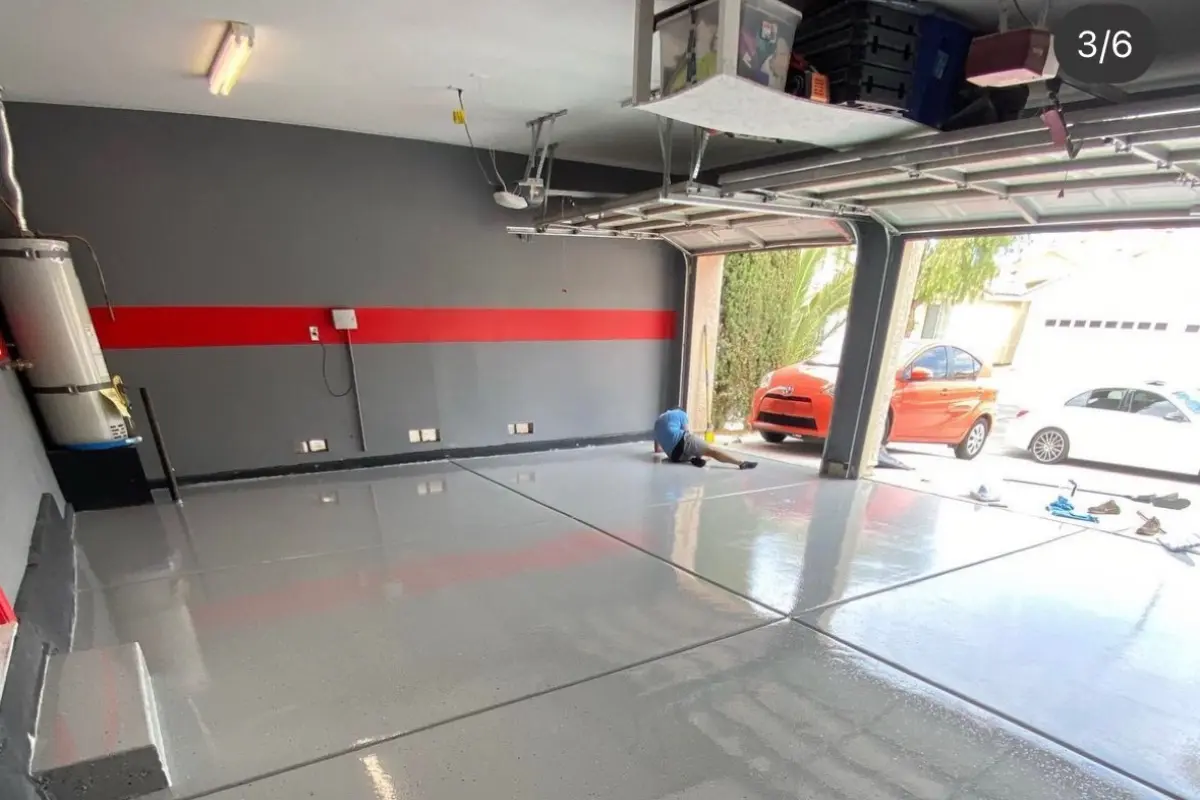
A garage floor in Las Vegas deals with conditions most flooring products were never designed for. Direct sun through an open garage door, slab surface temperatures that can exceed 140°F in summer, and UV exposure that never really lets up for most of the year. Picking the right epoxy garage floor coating here isn’t about aesthetics first, it’s about picking a system that survives the climate. Here’s what actually matters.
Why Standard Epoxy Struggles in Las Vegas Heat
Epoxy resin is a strong, durable coating, but its weak point has always been UV stability. Straight epoxy, without a protective topcoat, will start to amber and chalk when exposed to sustained sunlight. In most climates that’s a slow cosmetic issue. In Las Vegas, where garage doors get left open on hot days and slabs bake in direct sun for months at a time, that yellowing shows up faster and more visibly.
Heat also affects the coating during installation and over its lifespan. A slab that’s too hot when material is applied can cause the epoxy to cure unevenly or trap bubbles. Once installed, a coating that isn’t rated for high heat cycling can soften slightly under extreme surface temperatures and become more vulnerable to scuffing or hot tire pickup.
Hot Tire Pickup: What It Is and Why It Happens Here
Hot tire pickup is when a vehicle’s tires, softened by heat from driving, partially lift or peel the coating when the car is parked and the tires cool and contract. It’s one of the most common complaints with lower-grade coatings in hot climates.
Two things reduce hot tire pickup risk: proper surface prep so the coating bonds mechanically to the concrete rather than just sitting on top, and a fully cured, dense film. This is why rushed jobs, or DIY kits with short or skipped cure windows, are more prone to this problem in Las Vegas than in cooler markets. If your car sits in direct sun all day and the garage slab is baking, the coating needs every bit of that bond strength.
Coating Systems That Handle Desert Heat Best
100% Solids Epoxy Base with Polyaspartic Topcoat
This is the combination most contractors recommend for Las Vegas garages that get real sun exposure. The epoxy base gives you thickness and bond strength, the polyaspartic topcoat gives you UV stability and a faster, more heat-tolerant cure. Polyaspartics also handle rapid temperature swings between the cool morning application window and the afternoon heat better than straight epoxy topcoats. For a deeper side-by-side, see our polyaspartic vs. epoxy comparison.
Polyurea/Polyaspartic Hybrid Systems
Increasingly common for garages that see heavy vehicle traffic or direct sun most of the day. These systems cure fast, which matters in summer when slab temps can make longer epoxy cure windows unreliable, and they resist UV degradation well.
Flake Broadcast Systems with UV-Stable Topcoat
Flake systems add texture and hide minor surface flaws, useful on older slabs. Paired with a UV-stable topcoat, flake floors hold their color better than a straight epoxy floor left exposed to open-door sun exposure.
What to Avoid
Water-based epoxy with no topcoat, and any single-coat DIY kit marketed as one-day installation without mention of UV protection. These tend to hold up fine in shaded, climate-controlled garages elsewhere in the country, but in direct Las Vegas sun they yellow and wear faster than the labor and material cost justifies.
Thermal Expansion and Slab Movement
Concrete expands and contracts with temperature, and Las Vegas sees some of the widest daily temperature swings in the country, especially in shoulder seasons when it can be 50°F at night and 95°F by afternoon. That movement stresses any coating applied on top.
Coatings with some flexibility (polyaspartic and polyurea formulations tend to have better flexibility than rigid epoxy alone) handle this expansion and contraction better without cracking or delaminating at joints. This is also why control joints and existing slab cracks need to be addressed correctly during prep, either honored with a flexible joint filler or bridged appropriately, rather than coated straight over.
Pricing Context for Desert-Rated Systems
Basic 100% solids epoxy without a UV topcoat runs roughly $3-$7 per square foot, but it’s not the recommended choice for a Las Vegas garage that sees real sun. Adding a polyaspartic or polyurea topcoat for UV and heat protection typically pushes pricing to $5-$9 per square foot. Flake and metallic systems with UV-stable topcoats run $7-$12 per square foot. The premium over basic epoxy is a real investment in longevity for this climate, not an upsell for its own sake. See our full garage floor epoxy cost breakdown for pricing by garage size.
Common Mistakes in Desert Climates
Choosing a coating based on price alone without asking whether it includes a UV-stable topcoat. Coating a slab without checking for existing moisture or grading issues that direct summer sun and monsoon runoff can both aggravate. Applying coating during peak summer heat without proper slab temperature management, which can affect cure quality. Ignoring visible cracks or control joints instead of addressing them before coating.
Why Hire a Pro for a Desert-Climate Garage Floor
Getting this right requires knowing how local heat and UV exposure affect cure times, material selection, and long-term performance, not just applying a coating by the book instructions on a kit. A professional crew manages surface prep, moisture and temperature conditions, and selects a system rated for how your specific garage is actually used and exposed to sun, rather than a one-size-fits-all product. Curious how long a properly installed system should actually hold up? See how long epoxy lasts in the desert for realistic lifespan numbers by system type.
FAQ
What’s the best epoxy coating for a Las Vegas garage that gets full sun through an open door?
A 100% solids epoxy base with a polyaspartic or polyurea topcoat. The topcoat is what actually prevents yellowing and holds up to the heat, the epoxy base provides the durable foundation.
Will my garage floor coating yellow if I leave the door open during summer?
Straight epoxy without a UV-stable topcoat likely will, over time. A polyaspartic or UV-stable polyurea topcoat is designed specifically to prevent that kind of sun-driven discoloration.
Can epoxy really handle a slab that hits 140°F in the summer?
Yes, when it’s the right system installed correctly. Properly prepped and cured epoxy with a heat-tolerant topcoat handles Las Vegas slab temperatures without softening or lifting under normal vehicle use.
Does the time of year matter for installation in Las Vegas?
It can affect cure conditions. Extreme summer heat requires careful timing and sometimes early morning application to keep the slab and ambient temperature in the right range during cure. Spring and fall are often easier windows, but summer installs are done successfully with the right process.
How do I stop hot tire pickup on my new epoxy floor?
Make sure the installer uses proper mechanical surface prep (grinding, not just acid etching) and allows full cure time before you park a vehicle on it. Choosing a polyaspartic or polyurea topcoat also reduces the risk compared to basic epoxy alone.
Is metallic epoxy a good choice for a hot, sun-exposed garage?
Yes, as long as it’s finished with a UV-stable topcoat. The metallic pigment layer itself isn’t inherently more heat resistant, the protection comes from the topcoat system on top of it.
Ready to get a coating system built for actual Las Vegas heat instead of a generic garage floor kit? Contact Reveles Concrete for a free estimate.