

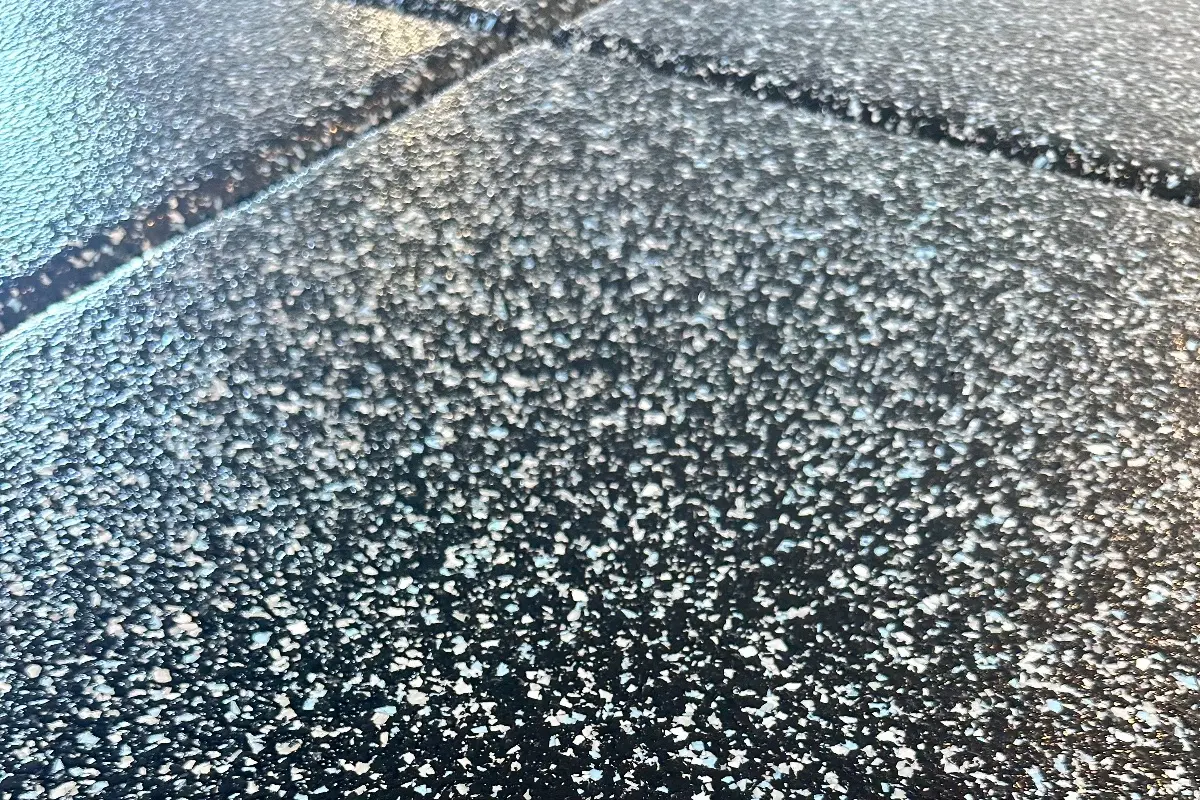
The lines cut into a concrete slab are not damage and they are not decoration. They are the places the slab is meant to move. They are also, more often than anything else, the reason a newly coated patio, pool deck or garage floor shows a crack within its first year.
The mistake is consistent. Joints get treated as blemishes, filled with something rigid and coated across, and the slab then does exactly what it was always going to do.
What the joints are there for
Concrete shrinks as it cures and it moves with temperature. In this valley the second part is substantial: an unshaded slab swings through an enormous surface temperature range between a July afternoon and a January night, and it expands and contracts through every one of those cycles.
Control joints are the saw-cut or tooled lines in the field of a slab. They create a weakened plane so the shrinkage crack happens in a straight line you chose instead of wandering across the surface.
Expansion or isolation joints separate the slab from something that moves differently: the house, a pool shell, a column, a step. They are normally filled with a compressible material rather than being a plain cut.
Construction joints are where one pour met another. Whether they move depends on how the two were tied together.
These are three different things with three different behaviors, and they are detailed differently. A quote that calls all of them “the lines” has not made the distinction.
What goes wrong when they are coated across
A film bonded across a moving joint has to absorb that movement within a very narrow band of material, and it cannot. One of three things follows.
The coating cracks along the joint line. This is the least bad outcome. It is a visual problem only, and the crack lands where a line was already expected.
The coating cracks somewhere else. When the joint has been bridged strongly enough, the movement relieves itself at the next weakest point instead. That crack is random and far more conspicuous.
The coating lifts along the joint edges. Water then gets underneath, and the failure spreads outward from the line rather than staying put.
None of these is a product defect. Each is a detailing decision made earlier in the project.
How joints are handled properly
Carry them through. The joint remains a joint in the finished surface. In a textured or decorative finish it is easy to make it read as part of the design. In a smooth floor it reads as a deliberate line, which is what it should be.
Fill them with a flexible sealant chosen for movement capability, and for ultraviolet exposure if the joint is outdoors, and for chemical exposure if it is near a pool. A rigid patching compound in a moving joint is not a filled joint.
Detail the perimeter isolation joints carefully. The line where a deck meets the pool coping, and the line where a patio meets the house, are the two that fail most often. Water entering either one becomes a problem well beyond the coating.
Re-cut where the existing pattern is inadequate. This happens, and it is a scope decision made in advance rather than an improvisation by the crew on installation day.
Telling a joint from a crack
The distinction is easy once you know what separates them.
A control joint is straight, consistent in width, and usually part of a regular grid related to the slab edges. A crack wanders, varies in width along its length, and frequently starts at an inside corner, such as the corner of an L-shaped patio or the corner of a step.
A joint that has opened wider than it was cut is working as intended. A tight crack with both sides at the same height may be dormant and a candidate for routing and filling. A crack with vertical displacement, or one that opens and closes seasonally, is active, and that is a different conversation. Crack assessment ahead of a coating is covered in concrete crack repair before coating.
The pool deck, which has the most joint conditions
A pool deck carries more joint types than almost any other residential slab: the expansion joint at the coping, the control joint grid in the field, isolation joints at raised features, and frequently a transition to a patio poured at a different time.
The joint at the coping is the one to watch. It absorbs the difference in movement between the pool shell and the deck while taking pool chemistry, ultraviolet light and constant wetting. The sealant in it has a finite life and is a maintenance item rather than a permanent installation. When it fails, water gets behind the coping.
Resurfacing options for that surface are on the pool deck coatings page, and the related slip question is in slip resistant pool deck coating.
Garage floors have them too
A garage slab has control joints, and the same rule applies with one difference: the floor is interior, dry and smooth, so a joint carried through reads as a visible line in an otherwise continuous surface.
That bothers some owners, which is why the conversation belongs at the quoting stage. A flake or decorative finish disguises a joint far better than a solid color does, which is one practical argument for the systems described in why garage floor flake epoxy hides dust and tire marks.
The alternative, filling the joint rigidly and coating over it for a seamless look, is a decision to accept a crack along that line later. Some owners make it knowingly, which is fine. Making it without being told is not.
Water, joints and this climate
Rain arrives here in concentrated bursts, and an open or failed joint takes that water below the slab, where it softens the base. Over several seasons that contributes to the settlement that lifts one side of a joint relative to the other.
Keeping joints sealed is therefore a drainage measure as much as a finish one. That is the argument for attending to them before the surface shows a problem rather than after one appears. The scheduling considerations around weather are in when to schedule floor coating in Las Vegas.
What belongs in the quote
A map of the existing joints, each classified as control, expansion or construction. How each is being carried through the finished surface. The sealant product and the reason it was chosen, including ultraviolet and chemical exposure. The perimeter and coping details specifically. Which cracks are being treated as dormant and routed, and which are being carried as joints. And the maintenance interval for the sealant.
Our preparation standards are in concrete surface preparation and our exterior work is on the patio coatings page.
Frequently asked questions
Can the joints in my patio be filled so they disappear?
Not durably, if they are moving joints. A control joint is a weakened plane where the slab is meant to crack, and an expansion joint separates two things that move differently. Fill either rigidly and coat across it and you get a crack along the same line, a crack somewhere else, or lifting at the joint edges. The joint is carried through the finished surface instead.
How do I tell a joint from a crack?
A joint is straight, consistent in width and usually part of a regular grid related to the slab edges. A crack wanders, changes width along its length and often begins at an inside corner, such as the corner of an L-shaped patio or a step. A tight crack with both sides level may be dormant; one with displacement or seasonal movement is active.
Which joint fails most often on a pool deck?
The expansion joint at the coping, where the deck meets the pool shell. It absorbs the movement difference between two separate structures while exposed to pool chemistry, ultraviolet light and constant wetting. Its sealant has a finite life and needs renewing. When it fails, water gets behind the coping, which is a bigger problem than a coating issue.
Do joints matter in a dry climate like Las Vegas?
Yes, and the driver here is thermal movement rather than freeze and thaw. An unshaded slab in this valley cycles through a very wide surface temperature range daily and seasonally, expanding and contracting every time. The joints are what give that movement somewhere to go. Rain matters too, because it arrives in concentrated bursts an open joint will take below the slab.
Will the joint line show in my new garage floor?
Yes, if it is carried through, which is the correct detail. How visible it is depends on the finish: a flake or decorative system disguises a joint far better than a solid color. The alternative is filling it rigidly for a seamless look and accepting a crack along that line later. Some owners choose that knowingly, and it should be a choice rather than a surprise.