

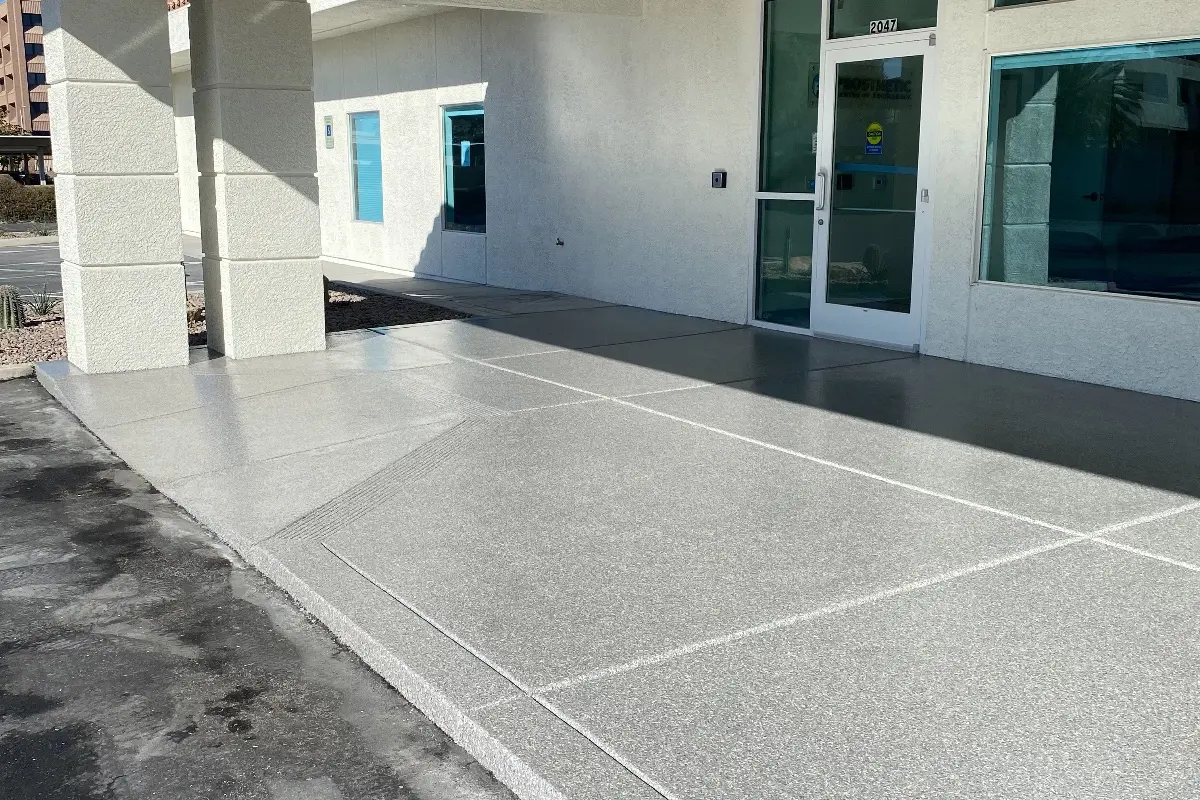
Both polyaspartic and epoxy coatings show up in nearly every quote for garage floors, patios, and commercial concrete in Las Vegas. They’re often lumped together as “the same thing” when they’re not. Each has different chemistry, different cure times, and different performance under the kind of sun and heat this valley deals with for most of the year. Here’s how they actually compare, and where each one makes sense.
What Each Coating Actually Is
Epoxy is a two-part resin system that chemically bonds as it cures, forming a hard, durable base layer. It’s been the standard for garage and industrial floors for decades because it’s tough, relatively affordable, and forgiving to apply. Its main weakness is UV sensitivity, standard epoxy will amber or yellow over time when exposed to sunlight, which is why it’s almost always paired with a topcoat for any surface that sees daylight.
Polyaspartic is a newer coating chemistry, technically a type of polyurea, known for fast cure times and strong UV resistance. It’s often used as a topcoat over epoxy base coats, but it can also be used as a standalone system in some applications. In Las Vegas, where sun exposure is intense almost year-round, polyaspartic’s UV stability is a real practical advantage, not just a marketing point. See our guide to garage floor coatings built for desert heat for which systems actually hold up under direct sun.
Cure Time: Hours vs Days
This is the most noticeable difference between the two.
Epoxy Cure Time
Standard epoxy needs real time to cure properly. Depending on the product and ambient temperature, expect 12-24 hours before the floor can handle foot traffic and several days, often 3-7, before it can handle full vehicle weight or heavy use. Cold weather slows this down further, though that’s less of a concern in Las Vegas outside of a few winter weeks.
Polyaspartic Cure Time
Polyaspartic cures dramatically faster, often within a few hours. Some systems allow foot traffic the same day and vehicle traffic within 24-48 hours. This is why polyaspartic has become popular for garage floors where homeowners don’t want their cars sitting in the driveway for a week, and for commercial spaces where downtime costs money.
The tradeoff is that polyaspartic’s fast cure gives installers a narrower working window to apply and tool the material correctly. It takes an experienced hand to get a clean finish before it sets up.
UV Stability: Why It Matters More in Las Vegas Than Most Places
Las Vegas gets over 300 days of sunshine a year, and surface temperatures on concrete driveways and garage floors with sun exposure can climb well above ambient air temperature. This matters for coating longevity in ways it doesn’t in cloudier climates.
Epoxy and UV Exposure
Standard epoxy is not UV stable on its own. Left exposed to direct or even indirect sunlight (through a garage door left open for hours, or on an uncovered patio), it will gradually yellow, chalk, or fade. This doesn’t necessarily mean coating failure, but it changes the appearance and can look dull or aged well before the coating actually wears out structurally.
Polyaspartic and UV Exposure
Polyaspartic resists yellowing and holds its color far better under direct sun. This makes it the better choice for any application with regular sun exposure: south or west-facing garages with doors frequently open, exterior patios, pool decks, or driveways. If you want the floor to still look like it did on install day two summers from now, polyaspartic’s UV resistance is the reason to lean that direction.
Application Temperature Range
Nevada’s install season brings its own complications. Summer slab temperatures can exceed what many standard epoxy products are rated for, and that affects working time and cure quality.
Epoxy Temperature Sensitivity
Most epoxy systems have a fairly narrow application window, often recommending ambient and surface temperatures roughly between 50-90°F. Applying epoxy in extreme heat can cause it to cure too fast, trap bubbles, or lead to poor adhesion. This is why many Las Vegas contractors schedule epoxy jobs for early morning hours during summer, or push heavier install schedules into fall and spring.
Polyaspartic Temperature Range
Polyaspartic tolerates a wider temperature range, including higher heat and, on some formulations, lower cold thresholds too. This flexibility is a genuine advantage in a market like Las Vegas, where contractors need to install floors through a long, hot summer without losing weeks of the calendar to unworkable heat.
Durability and Hot Tire Pickup
“Hot tire pickup” refers to a coating lifting, softening, or marking when a hot tire (from driving on scorching asphalt) parks on the surface and cools. It’s a real problem in desert climates.
Both epoxy and polyaspartic can experience hot tire pickup if under-cured, applied too thin, or if the wrong product is used for the application. Polyaspartic topcoats generally have a reputation for better resistance to this issue due to their flexibility and chemical structure, but the base coat and overall system thickness matter just as much as which topcoat sits on top. A well-installed epoxy system with a quality polyaspartic topcoat tends to perform best against hot tire pickup in Las Vegas garages.
Cost Differences
Polyaspartic systems generally cost more than basic epoxy, mainly because the material itself is pricier and the fast cure time demands more skill and speed from the installer. As a rough guide:
- Basic 100% solids epoxy systems: $3-$7 per sq ft
- Premium systems with polyaspartic topcoats, flake, or metallic finishes: $7-$12 per sq ft
Many Las Vegas contractors use a hybrid approach: an epoxy base coat for strength and cost efficiency, topped with a polyaspartic clear coat for UV resistance and fast cure. This gets you the durability of epoxy with the sun protection and quick turnaround of polyaspartic, without paying full price for an all-polyaspartic system.
Which One Is Better for Which Use Case
Garage Floors
For a typical garage, an epoxy base with a polyaspartic topcoat is usually the sweet spot, especially for garages that see regular sun through an open door. If budget is the main driver and the garage stays closed most of the day, a basic epoxy system still performs well.
Patios and Outdoor Living Spaces
For anything outdoors and exposed to direct sun year-round, polyaspartic is the stronger choice. The UV resistance keeps the color looking right, and the wider temperature application range makes it easier to install correctly during Vegas’s long hot season. See our pool deck and patio coatings guide for outdoor-specific system options.
Commercial and High-Traffic Spaces
Businesses that can’t afford days of downtime often lean toward polyaspartic specifically because of the fast cure and quick return to service. Warehouses, retail spaces, and garages that double as workspaces benefit from getting back in operation within a day instead of a week. See our commercial epoxy flooring guide for industry-specific system recommendations.
FAQ
Can polyaspartic be applied directly over old epoxy?
In most cases, yes, as long as the existing epoxy is sound, clean, and properly profiled or lightly sanded for adhesion. This is a common way to refresh a yellowed epoxy floor without a full tear-out.
Will epoxy yellow in a Las Vegas garage even if I keep the door closed most of the time?
Some yellowing can still happen from ambient light and heat over years, but it’s far less pronounced than in garages with regular direct sun exposure. Closed garages generally see epoxy hold its color longer.
Is polyaspartic worth the extra cost for a typical residential garage?
For a garage that gets regular sun exposure or where you want the fastest possible turnaround, yes. For a rarely-opened garage on a budget, a quality epoxy system with a UV-stable topcoat can still perform well for years.
How soon can I drive on a polyaspartic garage floor in Las Vegas?
Many polyaspartic systems allow vehicle traffic within 24-48 hours, though this depends on the specific product and installation conditions. Your contractor should give you a firm timeline based on what they installed.
Does Las Vegas heat make epoxy installation harder in the summer?
Yes. High surface and ambient temperatures can cause standard epoxy to cure too fast or trap air, which is why many installers schedule epoxy work for early morning during peak summer months, or recommend polyaspartic for its wider application temperature range.
Which coating handles hot tire pickup better?
Polyaspartic topcoats generally resist hot tire pickup better than standard epoxy topcoats, but proper installation, adequate cure time, and correct system thickness matter just as much as the product choice itself. For realistic lifespan numbers by system type, see how long epoxy lasts in the desert.
Get the Right System for Your Floor
The right choice between polyaspartic and epoxy depends on your specific space, how much sun it gets, and how fast you need it back in use. Reveles Concrete can walk your floor, explain what system fits your situation, and give you a free estimate with no pressure attached. Reach out today to get started.