

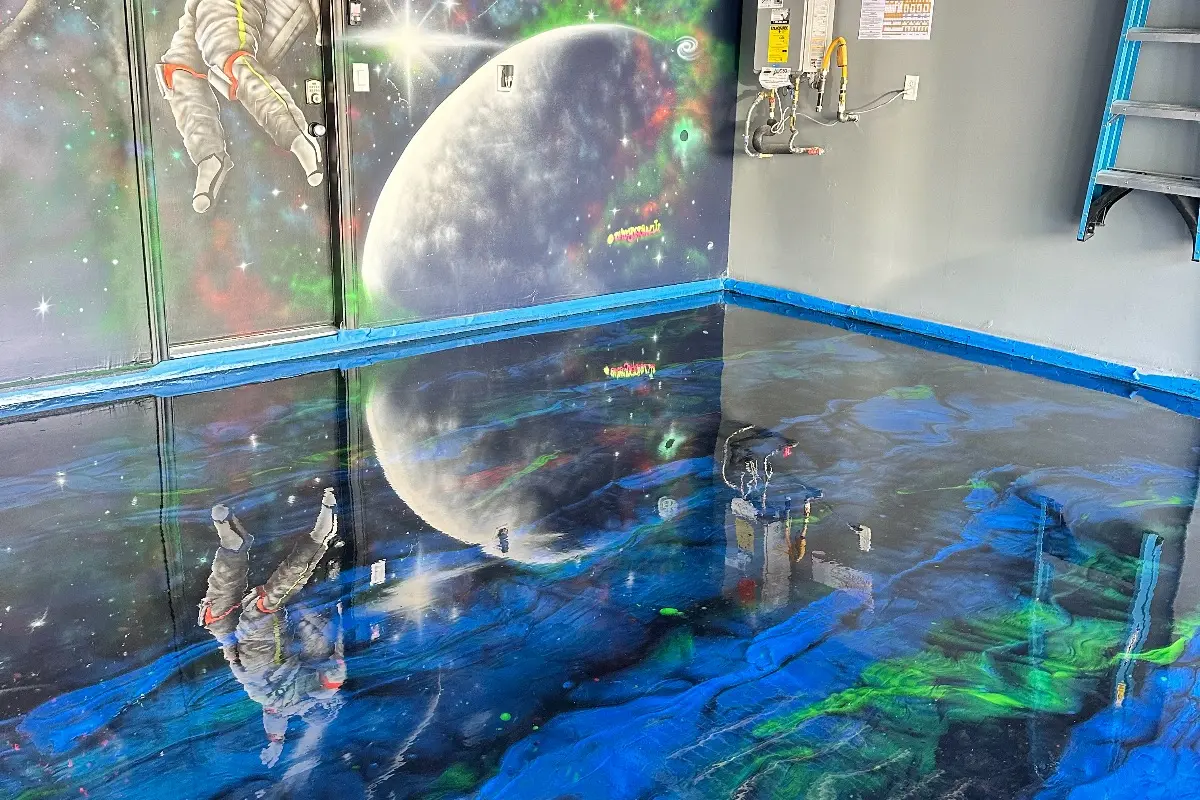
Metallic epoxy is what happens when you take a standard epoxy floor and turn it into a piece of art. Instead of a flat color or flake finish, metallic epoxy uses specialized metallic pigments suspended in the epoxy resin that move and react as the coating is applied, creating three-dimensional, marbled, almost molten-looking patterns. No two metallic epoxy floors look exactly the same, which is a big part of the appeal for homeowners who want something that doesn’t look like every other garage or patio on the block.
If you’re considering upgrading a garage, showroom, or patio in the Las Vegas area, metallic epoxy is worth understanding before you commit, both for what it can do design-wise and what it takes to hold up in a desert climate.
What Is Metallic Epoxy Flooring?
Standard epoxy coatings use pigments that create a flat, uniform color. Metallic epoxy uses mica-based or specialty metallic pigments mixed into a clear or tinted epoxy base. As the installer pours and manipulates the material, the pigments separate and swirl, creating depth, movement, and a glossy, almost liquid appearance once cured. Under the right lighting, the floor can look like it has actual dimension and motion frozen in place.
The effect depends heavily on how the material is applied. Technique matters as much as the product itself, which is why metallic epoxy is considered a more skill-dependent installation than standard flake or solid-color epoxy.
Popular Design and Color Options
Metallic epoxy gives you far more design range than traditional flake or solid epoxy. Some of the most requested looks include:
- Ocean and lagoon blues for a cool, water-like effect that works well in showrooms and patios.
- Charcoal and silver swirls for a more industrial, high-end garage look.
- Bronze, copper, and gold tones that read warm and upscale, popular in man caves and living spaces.
- Multi-color blends combining two or three metallic pigments for a more dramatic, custom effect.
- Single-tone metallics for buyers who want the dimensional look without a busy pattern.
Because the pattern forms during application rather than from a pre-made product, every floor is one-of-a-kind. Homeowners working with an experienced installer can also request specific color combinations to match a car collection, home decor, or branding for a commercial space.
Where Metallic Epoxy Gets Used
Garages are the most common application, especially for homeowners who use their garage as more than just parking, car enthusiasts, home gyms, workshops, and entertaining spaces all benefit from a floor that looks finished rather than utilitarian.
Showrooms, whether for vehicles, retail products, or art, use metallic epoxy to create a backdrop that elevates whatever is displayed on it. The reflective, dimensional quality catches light in a way that plain concrete or standard tile can’t match.
Man caves and basements are a natural fit since metallic epoxy turns a functional room into a statement space without needing much else in the way of decor.
Patios and outdoor living areas can use metallic epoxy too, though outdoor installations need extra attention to UV stability and substrate movement, which we cover below. See our pool deck and patio coatings guide for outdoor-specific system recommendations.
Commercial lobbies in offices, restaurants, and retail spaces increasingly use metallic epoxy as a design feature. It photographs well, holds up to foot traffic, and gives a space a custom, high-end feel without the cost of natural stone.
How Metallic Epoxy Holds Up to Las Vegas Sun and Heat
Las Vegas puts flooring through a stress test most other climates don’t. Summer slab temperatures can climb well past what the coating experiences in more moderate climates, and UV exposure is intense and near-constant for months at a time.
Standard epoxy resin is not UV stable on its own. Left exposed to direct sun, it will amber, yellow, or dull over time, which is a real problem for a floor whose entire value proposition is its appearance. That’s why any metallic epoxy floor with sun exposure, whether in a garage with a west-facing door that gets afternoon light or a patio installation, needs a UV-stable topcoat, typically a polyaspartic or aliphatic urethane, applied over the metallic base coat.
This topcoat does double duty. It protects the metallic pattern underneath from UV degradation and it adds a layer of durability and chemical resistance on top of the decorative coat. For patio applications specifically, the topcoat also needs to handle direct sun exposure, occasional water pooling, and the thermal expansion and contraction that comes with big day-to-night temperature swings in the desert.
Garages with insulated doors and less direct sun exposure have an easier time long-term, but a quality UV-stable topcoat is still the right call for any metallic floor in this climate, indoor or outdoor.
Installation Process: Metallic Epoxy vs. Standard Epoxy
Standard flake or solid-color epoxy installation is relatively forgiving. Pour, spread, broadcast flake if using it, topcoat. Metallic epoxy asks more of the installer at every step.
Surface prep still comes first. Grinding or shot-blasting the concrete to open the pores and remove contaminants matters even more with metallic epoxy because any inconsistency in the substrate will show through the translucent metallic effect in ways it wouldn’t with a solid color.
Application technique drives the final look. Installers use specific pouring patterns, squeegee and trowel techniques, and sometimes tools like torches or blowers to manipulate the pigment while the material is still workable. Moving too fast, too slow, or unevenly changes the pattern significantly. This is the biggest reason metallic epoxy costs more and why experience matters more here than with other coating types.
Working time is tighter. Metallic epoxy needs to be manipulated while wet, which gives installers a narrower window to get the effect right before the material starts to set. Larger spaces sometimes get poured in sections to manage this.
Topcoat application requires precision too. An uneven topcoat can create hazing or dull spots that mute the metallic effect underneath, so the same care that went into the base coat needs to carry through the final layer.
Cost of Metallic Epoxy Flooring
Metallic epoxy sits at the higher end of coating pricing, typically running $8 to $12 per square foot installed, compared to $3 to $7 for standard solid-color or basic flake epoxy. The premium reflects the labor-intensive application process, the cost of metallic pigments, and the UV-stable topcoat that a quality installation requires.
Final pricing depends on square footage, substrate condition, color complexity, and whether the space needs crack repair or leveling before installation. A small two-car garage will cost less in total than a large patio or showroom floor, but the per-square-foot rate is fairly consistent within that $8-$12 range for genuine metallic systems. See our full epoxy flooring cost guide for how metallic compares to other systems, or our garage floor epoxy cost breakdown for pricing by garage size.
FAQ
How long does a metallic epoxy floor last in Las Vegas heat?
With a proper UV-stable topcoat, a metallic epoxy floor can hold its color and finish for many years under Las Vegas sun exposure. Without that topcoat, expect amber discoloration and dulling well before that, especially in west or south-facing garages and any outdoor application.
Can metallic epoxy be installed on an outdoor patio?
Yes, but it needs the right system. Outdoor metallic epoxy installations require a UV-stable topcoat rated for direct sun and should account for water drainage and the concrete’s expansion joints so the coating isn’t fighting substrate movement over time.
Will my metallic epoxy floor pattern look like the photos I’ve seen online?
Not exactly, and that’s part of the appeal. The swirl, marbling, and depth of a metallic epoxy floor form during application and are influenced by technique, so your floor will be unique to your space. A skilled installer can steer the color palette and general effect toward a look you like, but it won’t be an identical replica of another floor.
Does metallic epoxy get slippery when wet, especially in a garage?
Cured epoxy has a glossy finish that can be slick when wet. Most installers can add a texture additive to the topcoat to improve traction without significantly changing the visual effect, which is worth discussing upfront if the garage sees rain tracked in or regular washdown.
Is metallic epoxy more prone to scratching than standard epoxy?
The metallic base coat itself isn’t inherently softer than standard epoxy, but scratches and wear show more visibly against the reflective, dimensional finish. A quality polyaspartic or urethane topcoat adds scratch and abrasion resistance and is strongly recommended for metallic floors in garages or high-traffic areas.
Can I match metallic epoxy colors to my car, decor, or brand colors?
Within reason, yes. Metallic pigments come in a range of base tones that can be combined and adjusted, and an experienced installer can talk through which combinations will realistically achieve the look you’re after before work begins.
Get a Free Estimate
If you want a garage, showroom, or patio floor that looks like nothing else on the street, Reveles Concrete can talk through color options, walk your space, and build a metallic epoxy plan suited to Las Vegas heat and sun. Request a free estimate today and see what’s possible for your floor.