

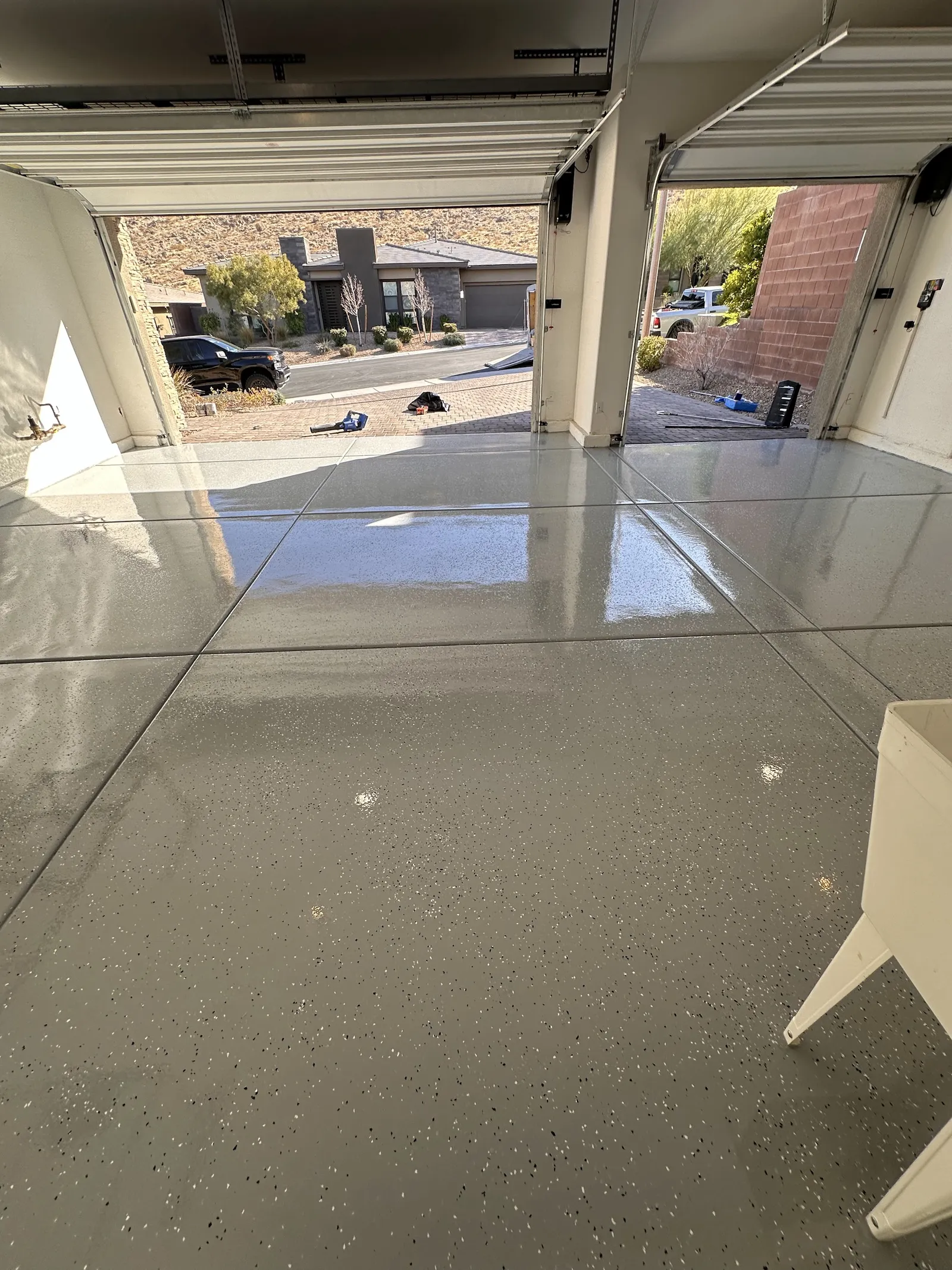
A garage in the Las Vegas valley is not a mild environment. It is an uninsulated concrete box with a large uninsulated door facing whatever direction the builder pointed it, and in July the slab inside it can sit well above the outdoor air temperature for most of the afternoon. Las Vegas garage floor coatings live or die on how the installer handles that, not on which color flake went into the broadcast.
Most of the failures we get called to look at trace back to three decisions made before a single pail was opened: how the concrete was prepared, whether anyone measured the slab, and what the substrate temperature was doing during application and cure. Product choice matters, but it matters fourth.
What Las Vegas garage floor coatings are actually up against
Start with heat. Coating chemistry is temperature driven. As the substrate warms, the reaction accelerates, working time shortens, and the window in which you can still wet out the surface and pull a clean edge collapses. A two part epoxy that behaves predictably at moderate temperatures can go from pourable to unworkable in a fraction of its stated pot life on a hot slab. Crews compensate by mixing smaller batches, working earlier, and in some cases conditioning the space, and that has to be planned rather than discovered.
Then temperature swing. The valley’s daily range is wide, and a garage with the door raised follows it. Concrete and coating do not expand and contract at the same rate. Every cycle puts shear stress at the bond line and at every edge, joint and crack termination in the floor. A coating that is well bonded absorbs that. A coating sitting on a poorly profiled surface fails at the weakest point, usually an edge or a joint, and then walks inward.
Third, ultraviolet exposure at the door line. Standard epoxy is not UV stable. It ambers and chalks under direct sun, and the first few feet inside a west facing garage door gets a great deal of direct sun. That strip is the visual tell on a badly specified garage: the body of the floor still looks new and the entry is yellowed.
The system families, and what each one is for
Four families cover almost every residential garage in the valley.
Epoxy base with a broadcast and a topcoat. A high build epoxy body coat, vinyl chips or quartz broadcast into it while wet, then a clear topcoat over the top. The broadcast is what gives the floor texture and hides dust, tire marks and minor slab irregularity. The topcoat is what decides UV and abrasion behavior, so it should be a UV stable chemistry rather than more of the same epoxy.
Polyaspartic and polyurea systems. Faster cure, wider application temperature range, and inherently UV stable in the aliphatic grades. The trade off is a very short working time, which in summer here is measured in minutes. These systems are unforgiving of a slow crew and they punish poor preparation harder than epoxy does, because there is no time to correct anything. The common defects are documented in our guide to polyaspartic coating mistakes.
Hybrid builds. An epoxy body coat for build and adhesion, a polyaspartic or aliphatic urethane topcoat for color hold and abrasion. This is the most common specification for a garage that has to look right for years, and it is what most of our residential work uses. The full residential range sits on the residential flooring page.
Decorative and troweled systems. Metallic, quartz and other decorative builds belong to the decorative concrete finishes family. They can be used in a garage, but they are chosen for appearance and they need the same substrate work as anything else.
Hot tire pickup is an adhesion problem, not a color problem
A tire that has been on the road in summer arrives hot and stays hot for a while after the car is parked. Two things then happen at the contact patch. Heat softens a coating that is either under cured or thermoplastic in character, and plasticizers migrating out of the tire attack it chemically. When the car pulls away, the coating comes with the tire in a crescent shaped patch.
The fixes are all upstream. Full cure before vehicles return, which is a schedule decision. A topcoat rated for vehicular traffic rather than a general purpose clear. And adequate mechanical bond, because a coating that is well anchored resists the lift even when it softens slightly. Garage floor paint from a big box store fails this test almost every time, which is why so many valley garages have a coated floor with two bare crescents in it.
Preparation decides most of the result
Every coating manufacturer states a required surface profile, described on the concrete surface profile scale published by the International Concrete Repair Institute. Getting to that profile means mechanical work: diamond grinding, or shot blasting on larger or harder floors. Both remove the weak laitance layer at the top of the slab, take off old sealers and paint, and open the pore structure so the primer can key in.
Acid etching does not do the same job. It removes some laitance, it leaves salts and residue behind unless it is neutralized and rinsed thoroughly, and it does not reliably produce a measurable profile. In a closed garage with a floor drain it also creates a disposal problem. If a bid proposes etching on a garage that will carry vehicles, ask what profile they are targeting and how they will verify it. The methods and the trade offs between them are covered in our guide to concrete surface preparation.
Preparation also includes the things nobody photographs. Oil and transmission fluid have to be degreased and, where they have soaked in, ground out. Control joints and cracks have to be dealt with deliberately. Anchor bolts, floor drains and the door threshold all need detailing, and the perimeter needs a cut line so the coating terminates cleanly rather than feathering out onto the slab edge.
Moisture still matters in a desert garage
Homeowners here reasonably assume moisture is a wet climate problem. It is not. A slab on grade sits on soil that receives irrigation, and in many valley neighbourhoods the landscaping and the drip system run right up to the garage slab edge. Older slabs may have no vapor retarder beneath them. Monsoon season adds humidity spikes on top of that.
What matters is not whether the floor looks wet but what the internal relative humidity of the concrete reads, which is measured with probes set into the slab under ASTM F2170. A slab reading above the coating’s stated limit needs a moisture mitigating primer, or it will blister. That test is cheap relative to grinding a failed floor off, and it is worth insisting on. We cover what the readings mean in our guide to concrete slab moisture testing.
Scheduling and return to service
Cure times published by manufacturers assume a temperature. Above that temperature the reaction runs faster and below it slower, and the practical result in a Las Vegas garage is that a summer job and a January job have genuinely different schedules. Foot traffic usually returns well before vehicles do, and vehicle return is the number that matters, because parking early is what causes tire pickup on an otherwise good floor.
Any proposal should state both numbers explicitly. Our installation process page sets out how a job runs from first assessment to handover, and the seasonal side is covered separately in our piece on what drives coating cost, because schedule and scope are the two things that move a quote.
What a garage floor proposal should contain
Ask for it in writing and check for six things. The preparation method and the target surface profile. The moisture test method and the actual readings, not a statement that the slab was fine. Each product named separately: primer, body coat, broadcast and topcoat, with the topcoat identified as UV stable if any part of the floor sees sun. Crack and joint treatment, described specifically. Coverage rates or film thickness, so the build is quantified rather than assumed. And return to service times for foot traffic and for vehicles.
A proposal that names none of that is a price on a page. We work throughout the valley and across the state line into the eastern suburbs, and the Henderson garage floor page shows the same specification applied in that market. Full service coverage is on the services page.
Frequently asked questions
How long before I can park on a new garage floor coating in Las Vegas?
It depends on the system and on the slab temperature during cure, and it should be stated in your proposal rather than estimated afterwards. Foot traffic returns first, vehicle traffic considerably later, and the vehicle number is the one that matters. Parking before full cure is the single most common cause of hot tire pickup on a floor that was otherwise installed correctly.
Will a garage floor coating peel in Las Vegas heat?
Heat by itself does not peel a properly installed coating. What peels floors is a weak bond, and that comes from inadequate mechanical preparation, moisture pushing up through the slab, contamination that was coated over, or vehicles returning before cure. Heat accelerates all four, which is why a hot climate is unforgiving of shortcuts rather than hostile to coatings.
Does the sun coming through the garage door damage the floor?
It damages standard epoxy, yes. Epoxy is not UV stable and ambers and chalks under direct sun, which is why the strip just inside a sunlit door discolours first. The fix is a UV stable topcoat, typically an aliphatic polyurethane or polyaspartic, over the epoxy body coat. Specify the topcoat chemistry rather than assuming a clear coat is a clear coat.
Can you coat a garage floor that already has a failed coating on it?
Usually, but the old coating has to come off mechanically first, and the reason it failed has to be identified before anything new goes down. Coating over a delaminating floor buys you a new surface bonded to a failing one. Grinding or shot blasting the old system off, then testing the exposed slab, is the honest starting point.
Is a garage floor coating worth it on an older Las Vegas slab?
Often, but the slab decides. Sound concrete with static cracks and normal wear is a good candidate once it is prepared properly. A slab with active movement, heavy contamination or high internal moisture needs those issues addressed first, and any of them can change the scope significantly. That is what a proper assessment is for, and it should happen before a number is quoted.