

Summerlin sits on the western edge of the Las Vegas valley, up against the Spring Mountains, and that position changes what a floor coating has to do. Epoxy flooring Summerlin homeowners install takes harder afternoon sun, a wider swing between day and night temperature, and in most villages an architectural review process that has an opinion about anything visible from the street.
None of that makes coatings a bad idea here. It makes the specification and the sequence matter more than they do lower in the valley.
Why epoxy flooring Summerlin projects need a different specification
Start with the sun. The west side takes direct afternoon light with very little atmospheric relief, and elevation on the higher benches adds to the ultraviolet load. Standard epoxy is not ultraviolet stable. Left exposed it ambers, then chalks, and it does it unevenly, so the shaded half of a patio stays close to its original color while the exposed half drifts. On any surface that sees sun, the topcoat has to be an ultraviolet stable chemistry, typically an aliphatic polyurethane or a polyaspartic, and it has to be specified by name. The mechanism is covered in detail in our piece on ultraviolet stability and color hold.
Then the temperature swing. Clear desert nights up against the mountains give up heat fast, so a slab that was hot in the afternoon can be cold before midnight. Concrete and coating expand and contract at different rates, and every cycle works the bond line and the edges. This is why exterior work in Summerlin is unusually sensitive to preparation quality. A floor that is properly keyed into an open surface profile absorbs the movement. A floor sitting on a smooth troweled surface starts lifting at the perimeter and at the joints.
Third, the built environment. Summerlin is a master planned community and most villages sit under an association with architectural review. Anything visible from the street, which usually means the driveway, the front walk and sometimes the courtyard, is likely to need approval on color and finish before work starts. Confirm it with your own association early, because approval timelines are the most common reason a Summerlin project slips.
Where the coatings actually go
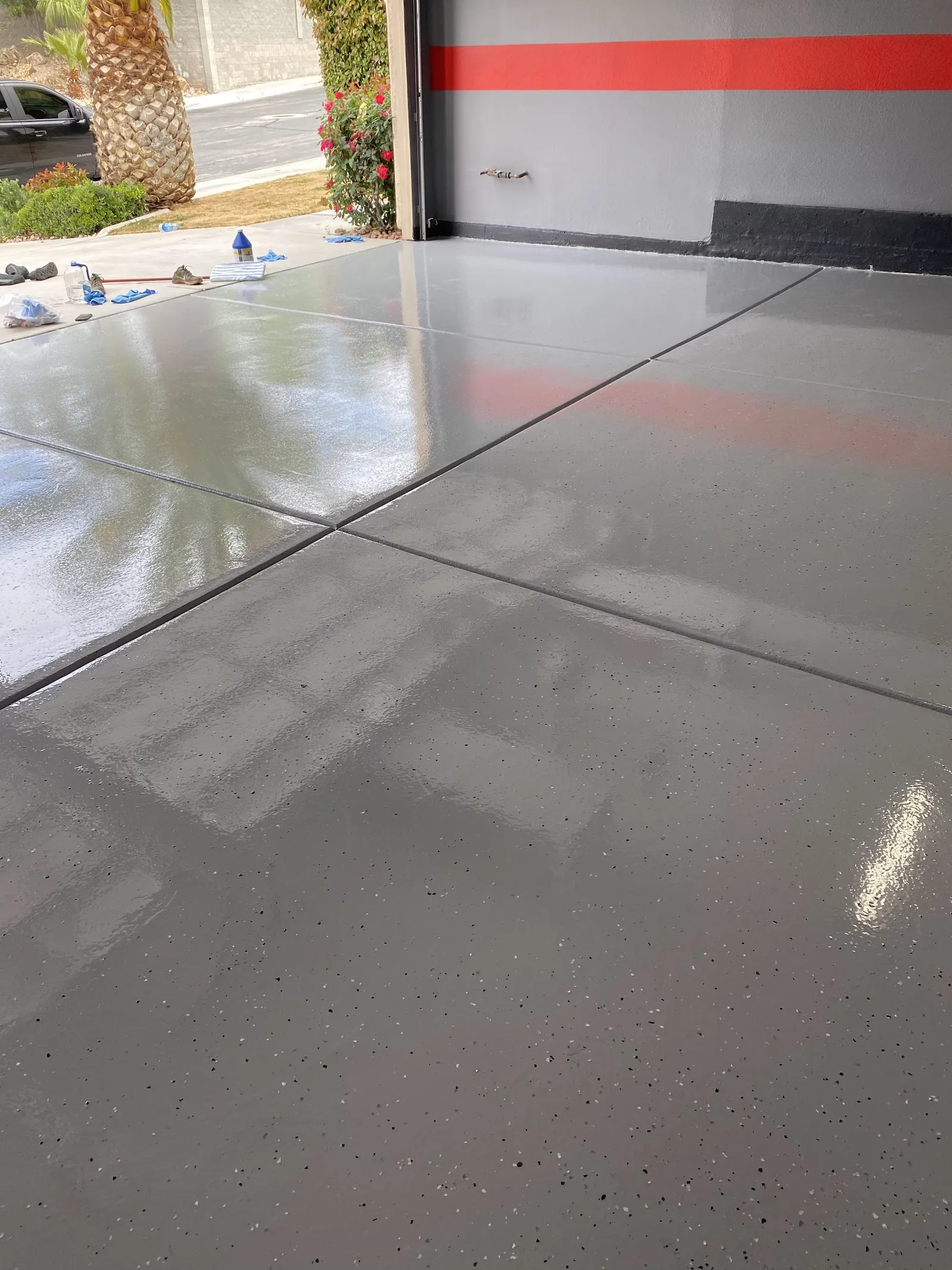
Garages are the largest category, and the specification is the same one that works across the valley: an epoxy body coat for build and adhesion, a broadcast for texture and appearance, and a topcoat chosen for ultraviolet stability and abrasion. West facing garage doors here take a great deal of direct light onto the first several feet of slab, so the topcoat decision is not optional. The full specification is in our Las Vegas garage floor coatings guide.
Covered patios and courtyards are the second category, and they are usually the most rewarding, because a patio is seen constantly and takes far less abuse than a driveway. Systems and finishes for these are on the patio coatings page, and where the surface continues around water the pool deck requirements take over and are handled on the pool deck coatings page.
Decorative interior work, entryways, casitas and finished garages that are used as living space fall under decorative concrete finishes, where the finish system is chosen for appearance first and the substrate work is identical.
Driveways are the hardest surface on any Summerlin lot and the one homeowners most often underestimate. A driveway takes full sun from mid morning to sunset, the largest thermal movement of any slab on the property, vehicle loads, and tires arriving hot off the asphalt. It is also the surface most likely to be visible from the street and therefore most likely to need architectural approval. Everything about the specification tightens: ultraviolet stable chemistry throughout rather than only in the topcoat, a texture that stays slip resistant when wet, and joint detailing that respects how much an exterior slab actually moves.
Slab conditions on the west side
Summerlin housing is comparatively young, which helps in one way and hurts in another. Newer slabs are more likely to have a vapor retarder beneath them, which reduces the risk of vapor drive from the ground. But newer slabs are also more likely to be power troweled to a hard, closed surface, and that dense finish is precisely the surface a coating cannot grip without mechanical preparation. Both facts point the same direction: prepare properly and test rather than assume.
The valley’s caliche hardpan runs under much of the west side too. Where it sits shallow and unevenly, support under a slab varies and cracking follows. Cracks are not a reason to abandon a coating project, but they have to be assessed for movement, treated accordingly and detailed before anything is applied, which is the subject of our guide to crack repair before coating.
One more west side condition worth naming: wind and grit. Summerlin sits close to open desert and to active construction on the outer villages, and fine dust moves constantly. Dust settling into a wet coat is a finish defect that cannot be polished out afterwards, so exterior work needs containment, a realistic read on wind conditions for the day, and a crew willing to stop rather than push through a gusty afternoon. Ask how the crew handles wind on an exterior pour. It is a fair question and the answer tells you a lot.
Timing a Summerlin project
Two clocks run at once here. The association clock, which is approval of color and finish for anything visible from the street, and the weather clock. Ignore the first and the project stops. Ignore the second and the floor suffers.
On the weather side, hot slabs shorten the working time of two part materials sharply, monsoon humidity brings dew point problems that show up as haze in a topcoat, and cold slabs in winter extend cure well past the published figures. Spring and autumn are the easy windows. Summer and winter both work with the right adjustments, and both need those adjustments planned into the schedule rather than improvised on the day. That is covered in our guide to scheduling a floor coating.
What a good Summerlin proposal looks like
It names the preparation method and the target surface profile. It names the moisture test and reports actual readings. It lists primer, body coat, broadcast and topcoat as separate products, and it states plainly that the topcoat is ultraviolet stable wherever sun reaches the surface. It describes how cracks and control joints will be treated rather than promising they will disappear. It gives return to service times for foot traffic and for vehicles. And where the work is visible from the street, it accounts for the association approval step in the schedule instead of leaving it to the homeowner to discover.
If a bid contains none of that, it is a price without a specification. Our coverage across the valley is listed on the service areas page, and the residential range is on the residential flooring page.
Frequently asked questions
Will an epoxy floor fade in Summerlin sun?
Standard epoxy will amber and chalk under direct sun, which is why it is never the finish layer on an exposed surface. The fix is an ultraviolet stable topcoat, usually an aliphatic polyurethane or a polyaspartic, applied over the epoxy body coat. Ask for the topcoat chemistry by name. A bid that only says clear coat has not answered the question.
Do I need HOA approval for a driveway or patio coating in Summerlin?
Most Summerlin villages sit under an association with architectural review, and anything visible from the street generally needs approval on color and finish before work begins. Rules and timelines vary by village, so confirm with your own association early. It is the most common cause of a delayed start on this side of the valley.
Are newer Summerlin slabs easier to coat?
They are usually cleaner and more likely to have a vapor retarder beneath them, which helps. They are also usually power troweled to a hard closed surface, which is harder to open up and demands proper mechanical preparation. Newer does not mean skip the preparation. It changes which equipment and which technique the crew should be bringing.
What is the difference between a patio coating and a pool deck coating?
A pool deck carries requirements a patio does not: wet slip resistance, surface temperature underfoot, and resistance to pool chemistry and splash out. Those push the specification toward a textured, cooler finish and different detailing at the coping. A covered patio away from water has more freedom on both texture and finish.
How long does a coating project take on a Summerlin home?
The installation itself is short. The schedule around it is what varies, driven by association approval where the work is visible from the street, by any crack or moisture remediation the assessment turns up, and by cure times that shift with the season. Ask for the return to service times in writing, for foot traffic and for vehicles separately.