

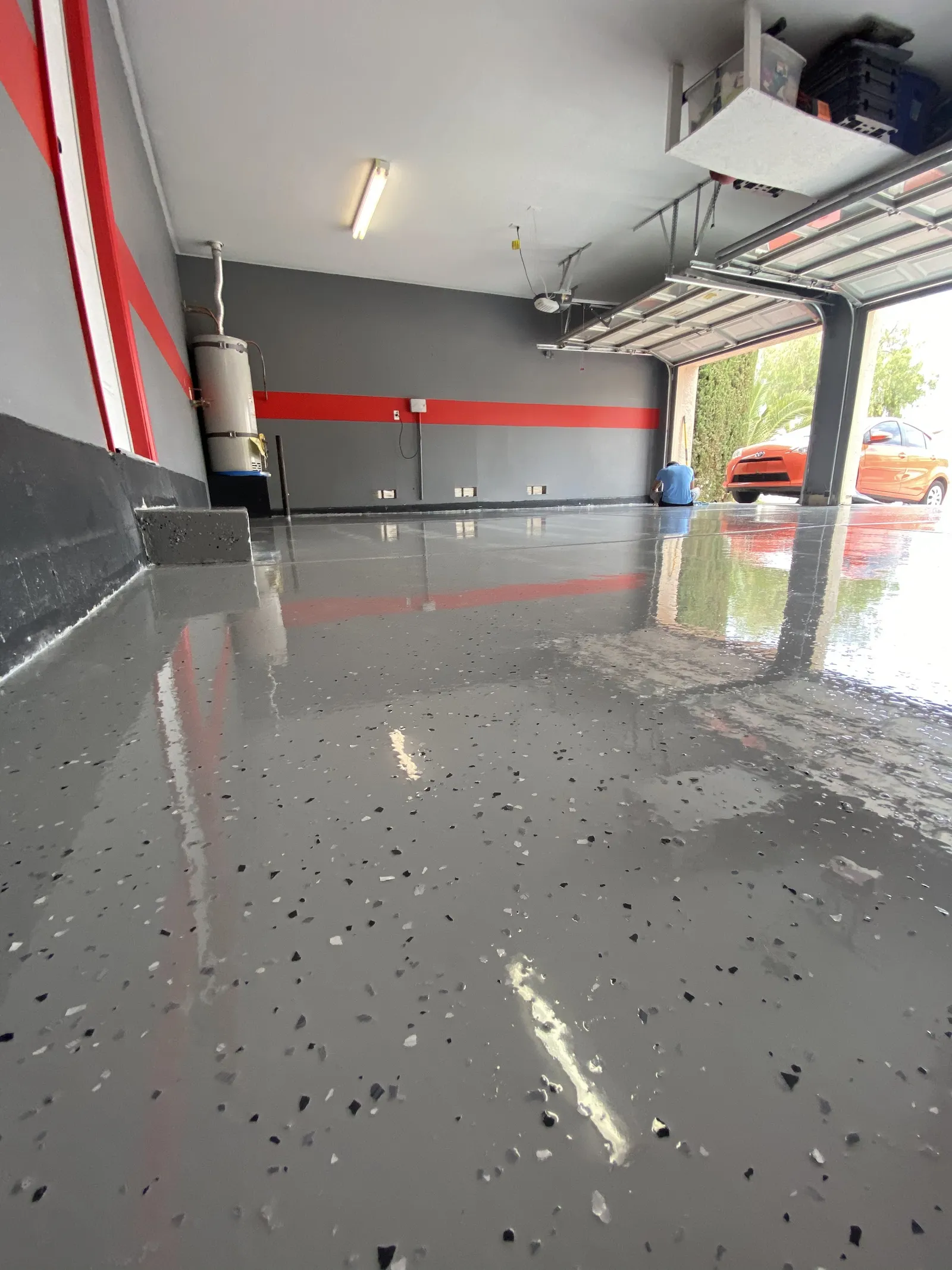
North Las Vegas is its own city, with its own building stock and its own mix of ground conditions, and epoxy flooring North Las Vegas homeowners buy has to answer those conditions rather than a generic sales sheet. The valley climate is the same across the metro. The slabs are not.
Most of what decides whether a coating lasts here happens before the first coat: what the concrete is sitting on, how the surface was finished when it was poured, how much sun the space takes, and whether anyone measured any of it.
What makes epoxy flooring North Las Vegas jobs different
Three local conditions come up again and again.
Caliche and hard layers under the slab. Much of the Las Vegas valley sits on caliche, a naturally cemented layer of carbonate hardpan. It is hard, it is not uniform, and where it is shallow it makes for very stiff support under one part of a slab and softer material under another. Differential support is what produces cracking that runs across a garage or a patio rather than following a joint. A coating does not cause those cracks and does not cure them, but it has to be detailed around them or it will telegraph and split.
Aggressive ground chemistry in places. Parts of the valley carry sulfate bearing soils, which is why local slabs are commonly specified with sulfate resisting cement. What that means for a coating is that the concrete you are bonding to is not always the mix you assume it is, and surface hardness varies more than it does in other markets. Preparation equipment and technique have to be matched to what the floor actually is, which is one more reason a bid written without seeing the slab is worth very little.
Sun angle and door orientation. A large share of North Las Vegas housing is tract built with garages that face the street, and street orientation decides how much direct sun the open door lets onto the slab. West and south facing doors take hard afternoon light onto the first several feet of floor every day. Standard epoxy is not stable under ultraviolet light. It ambers and chalks, and it does it in a stripe that follows the door opening.
The slab surface you are actually bonding to
Production housing slabs are usually power troweled to a hard, closed surface. That finish looks good and it is exactly wrong for a coating, because troweling drives fines and water to the top and leaves a weak layer of laitance sitting over the sound concrete. Bond a coating to laitance and the coating is only as strong as that layer, which is not very strong at all.
The answer is mechanical preparation that removes it and opens the pore structure to a measurable profile. Diamond grinding covers most residential work, shot blasting is used on larger or harder floors, and acid etching does not do the same job in either case. That is set out in full in our guide to concrete surface preparation.
Moisture, in a city that averages very little rain
Slab moisture is not a rainfall question. It is a question of what is under the concrete and what is being put into the ground around it. Irrigation on a drip system runs right against many valley foundations. Older slabs may have been poured without a vapor retarder beneath them. Newer slabs are sometimes coated before the concrete has finished releasing its own water of construction.
The reading that matters is the internal relative humidity of the slab, measured with probes set into the concrete under ASTM F2170, not a look at the surface. Where the reading exceeds what the coating tolerates, a moisture mitigating primer goes down first. Our guide to concrete slab moisture testing explains what the numbers mean and what to ask for.
Where coatings go in a North Las Vegas home
Garages are the bulk of it. The specification that survives here is an epoxy body coat for build and adhesion, a broadcast for texture and appearance, and a topcoat chosen for ultraviolet stability and abrasion rather than for cost. The full breakdown is in our Las Vegas garage floor coatings guide.
Driveways are the second most common request and the hardest environment on the property, because they take full sun all day, vehicle loads, and hot tires arriving off asphalt. Systems for exterior slabs are covered on the driveway coatings page and the heat specific side of it in our piece on driveway coatings in Las Vegas heat.
Interior living space, laundry rooms, casitas and workshops make up the rest, and those are covered under residential flooring. North Las Vegas also carries a large light industrial and distribution belt along the interstate and around the airport, and that work is handled separately through the commercial and industrial page rather than as a residential specification.
Working around the North Las Vegas calendar
Summer is workable but it is not free. On a hot slab the working time of a two part coating shortens sharply, which means smaller batches, earlier starts, and in some cases conditioning the space. Monsoon season adds humidity spikes, and humidity matters because the substrate has to stay above the dew point through application and cure or the film picks up moisture and hazes.
Winter is the opposite problem. Cure slows as the slab cools, and an uninsulated garage slab lags the air temperature by days. A January job and a July job on the same floor have genuinely different schedules, and both are fine as long as the schedule is planned rather than assumed. That is the subject of our guide to choosing when to schedule a floor coating.
What to ask a North Las Vegas contractor before you sign
Ask how they will prepare the slab and what surface profile they are targeting. Ask what moisture test they will run and to see the readings. Ask for the products by name, separated into primer, body coat, broadcast and topcoat, and ask specifically whether the topcoat is ultraviolet stable, because on a sunlit garage or a driveway that single answer decides how the floor looks in three years. Ask how cracks and control joints will be treated. Ask for return to service times for foot traffic and for vehicles.
Then ask them to look at the slab before they price it. A contractor who quotes a North Las Vegas garage over the phone has not seen the caliche cracking, the laitance, the oil staining or the door orientation, and every one of those changes the scope. Our coverage across the valley is set out on the service areas page.
Frequently asked questions
Is epoxy flooring a good choice for a North Las Vegas garage?
Yes, provided it is specified as a system rather than as a single product. An epoxy body coat gives build and adhesion, a broadcast gives texture and hides wear, and an ultraviolet stable topcoat protects the color where sun reaches through the door. Epoxy alone, with no protective topcoat, is the specification that yellows at the door line and gets blamed on the climate.
Do North Las Vegas slabs crack more than others in the valley?
Cracking here is usually about what is under the slab rather than which side of the valley it is on. Caliche hardpan is not uniform, and where support changes across a slab you get movement and cracking. It is a common local condition, it is manageable, and it has to be assessed and detailed before coating rather than covered over.
Can a coating be installed in a North Las Vegas garage in summer?
Yes, with adjustments. Hot concrete shortens the working time of the material significantly, so crews mix smaller batches, start earlier in the day and sometimes condition the space. What should not happen is a summer schedule that assumes the same working times as a spring one. Ask how the crew is handling substrate temperature before the job is booked.
How is a driveway different from a garage floor here?
A driveway takes full sun for the whole day, larger thermal movement, vehicle loads and hot tires arriving straight off asphalt. That pushes the specification toward ultraviolet stable chemistry throughout, a texture that stays slip resistant when wet, and more attention to joints, because an exterior slab moves more than an interior one.
Do you need to see the floor before quoting?
Yes, and any contractor who does not is guessing. Surface hardness, existing coatings, oil contamination, crack pattern, joint layout, moisture and door orientation all change scope, and none of them can be established over the phone. An assessment before a number is the difference between a quote and an estimate that moves later.