

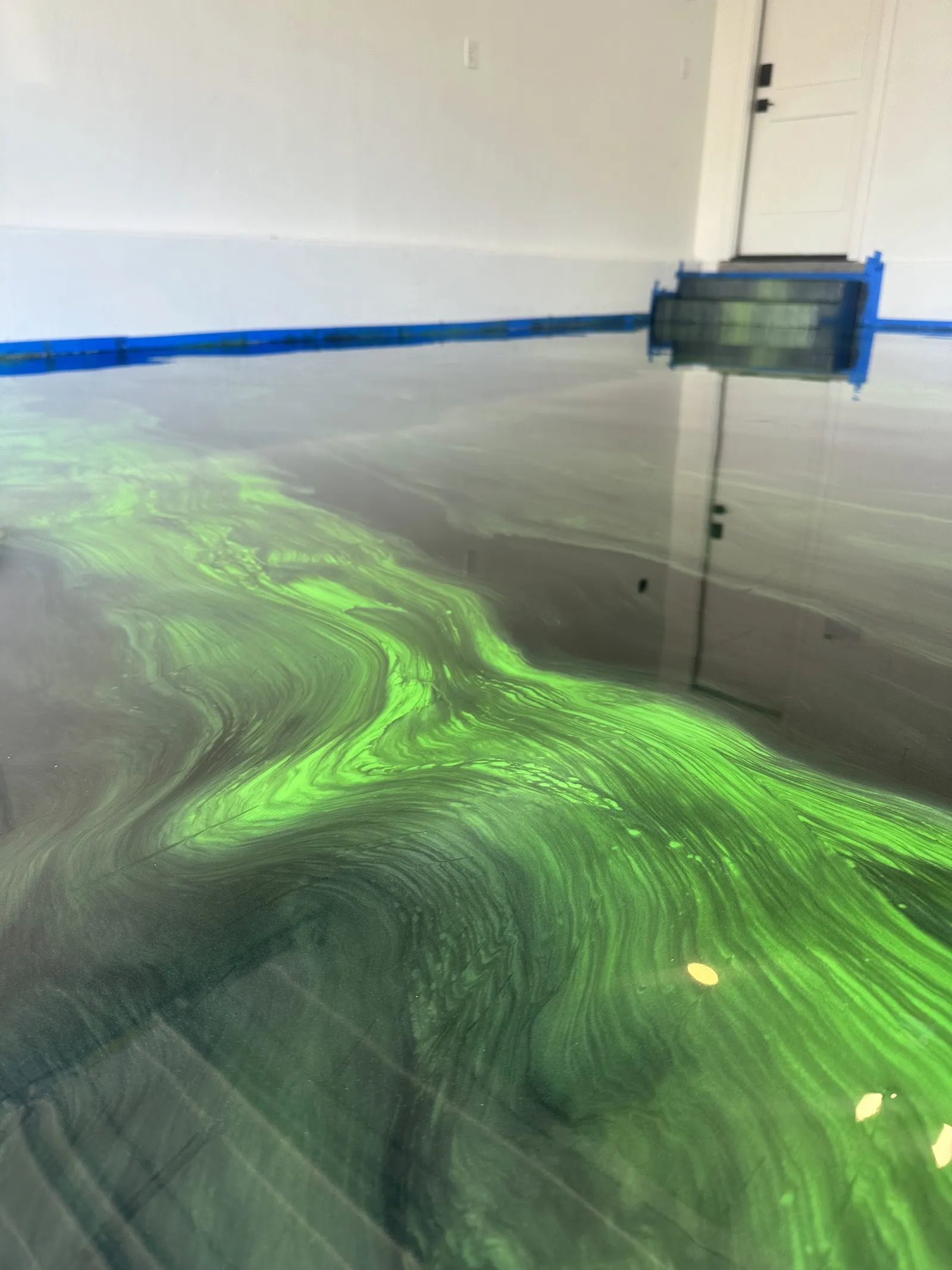
UV stable concrete coatings are not a premium option in this valley. On any surface that sees the sun, they are the difference between a floor that still looks like the sample in three years and one that has gone yellow, dull and patchy along the line where the light falls.
The failure is easy to recognize once you know what causes it. It is also entirely preventable at specification, and impossible to fix afterwards without recoating.
Why standard epoxy ambers in the sun
Most floor epoxies are built on aromatic chemistry, and aromatic rings absorb ultraviolet light. That absorbed energy drives photo oxidation in the cured film: the polymer breaks down at the surface, the color shifts toward yellow, gloss falls away, and eventually the surface chalks, leaving a powdery residue that comes off on a finger.
It happens in stages and it happens unevenly, following the light. In a garage it shows as a band inside the door where sun reaches the slab. On a patio it shows as a boundary where a wall or a column has cast permanent shade. That sharp line between the shaded and exposed halves of one continuous slab is the most convincing evidence there is that this is a light problem and not a product defect.
The chemistries that hold color
Aliphatic polyurethane. Aliphatic backbones do not have the aromatic rings that absorb ultraviolet the same way, so they resist yellowing and retain gloss far longer. Aliphatic urethanes have been the standard exterior topcoat across the coatings industry for decades for exactly this reason.
Polyaspartic. A polyaspartic is an aliphatic polyurea. It brings the same ultraviolet stability, cures fast, and is widely used as a topcoat over an epoxy body coat. The trade off is a very short working time, which in valley summer conditions demands an experienced crew.
Aromatic urethane. Cheaper, tougher in some respects, and not ultraviolet stable. It has legitimate uses below other coats or in areas that never see light. It is not a finish coat on a sunlit floor, and it is occasionally sold as one because the word urethane appears on the label.
The practical rule is that the body coat can be aromatic if it is protected, but the layer facing the sun has to be aliphatic. Ask for the topcoat by chemistry, not by the word clear.
Pigment matters as much as resin
Color hold has a second variable that gets almost no attention. Inorganic pigments, the iron oxides and similar mineral pigments, are far more stable under ultraviolet than most organic pigments, which is why earth tones, grays and blacks in a coating typically hold better than bright organic reds, blues and greens.
Titanium dioxide, the white pigment in almost every light colored coating, deserves a mention of its own. Some grades promote chalking at the surface under ultraviolet exposure, which is why coating grades intended for exterior use are specified rather than whichever white was cheapest.
Broadcast media are the good news. Vinyl flake and quartz aggregate are far more colorfast than most pigmented films, so a broadcast floor keeps its appearance longer than a solid color one. The topcoat over them still governs, because when the topcoat dulls the floor looks dull regardless of what is underneath. Finish options are on the decorative concrete finishes page.
Where UV stable concrete coatings matter most in Las Vegas
The garage door line is the most common. Sun reaches the first several feet of slab every afternoon on a west or south facing door, and that band ages years faster than the rest of the floor. The specification fix is simply to use a UV stable topcoat across the whole garage rather than treating the interior as if it never sees light. The full garage specification is in the Las Vegas garage floor coatings guide.
Driveways take it worst, because they are unshaded from mid morning to sunset and they carry traffic at the same time, so ultraviolet degradation and abrasion work on the same surface together. Exterior systems are on the driveway coatings page.
Patios and courtyards vary enormously depending on shade structures, and the partial shade case is the one that produces visible boundaries. That is a particular issue on the west side of the valley, which is covered in our Summerlin page. Covered patio systems are on the patio coatings page.
Two more exposures get overlooked. Rooms with large unshaded west facing glass put a moving band of direct sun across an interior floor for hours a day, and skylights do the same in a fixed spot. Both produce the same amber patch on an unprotected epoxy, and both surprise homeowners who assumed indoors meant safe. If sunlight lands on the floor, the floor needs the same topcoat as an exterior slab, and the cost difference between doing that and not doing it is one product on one coat.
The topcoat is a wear layer, by design
Even an aliphatic topcoat is consumed slowly by ultraviolet exposure and abrasion. That is expected and it is the point of a layered system: the sacrificial layer takes the damage so the body coat and the broadcast underneath do not. When the topcoat dulls, it is recoated, and the floor is renewed without touching anything below it.
This is why the system architecture matters more than any single product claim. A floor built to be recoated is maintainable. A single thick coat of anything is not, because there is no sacrificial layer and any renewal means starting over. Build and layering are covered in coating thickness and film build.
What to write into the specification
Name the topcoat product and its chemistry, and state that it is aliphatic. State the pigment approach where color is critical, particularly on large exterior areas in strong colors. Ask what recoat interval the manufacturer expects for the exposure, because that number is the maintenance plan. And ask what the warranty says about ultraviolet exposure, since it is one of the most common exclusions, as covered in floor coating warranties.
Where a floor has already yellowed and chalked, the surface has to be abraded and recoated with the correct chemistry rather than simply cleaned, and that sequence is in recoating a failed concrete floor.
Frequently asked questions
Does epoxy really turn yellow in Las Vegas sun?
Yes, and quickly on directly exposed surfaces. Most floor epoxies use aromatic chemistry that absorbs ultraviolet light, which drives photo oxidation at the surface: color shifts yellow, gloss goes, and eventually the surface chalks. It is not a defect, it is a known property of the chemistry, and the answer is an ultraviolet stable topcoat over the epoxy rather than a search for a better epoxy. Any supplier promising a UV proof epoxy is selling a topcoat and calling it something else.
What topcoat should I ask for on a sunlit floor?
An aliphatic chemistry, which in practice means an aliphatic polyurethane or a polyaspartic. Ask for it by name and by chemistry. The word clear on a proposal does not tell you whether the product will hold color, and aromatic urethanes are sometimes sold as topcoats because urethane appears on the label.
Will my flake floor fade?
The flake itself is comparatively colorfast, and quartz aggregate is more so. What dulls is the topcoat over it, and when the topcoat dulls the whole floor reads as faded even though the color underneath is intact. That is normal, it is why the topcoat is a sacrificial wear layer, and it is fixed by recoating rather than by replacing the floor.
Can a yellowed floor be restored?
Not by cleaning, because the change is in the cured film rather than on it. The surface is abraded to give mechanical key and a new ultraviolet stable topcoat is applied over it, provided the underlying system is still well bonded. If the body coat has also degraded or is delaminating, the floor needs full removal instead.
Do interior floors need a UV stable topcoat?
Any area that receives direct sunlight does, and that includes the band inside a garage door, a room with large unshaded windows, and anything under a skylight. Since the cost difference applies only to the topcoat, specifying an ultraviolet stable finish across a whole garage is usually the simpler and safer decision.