

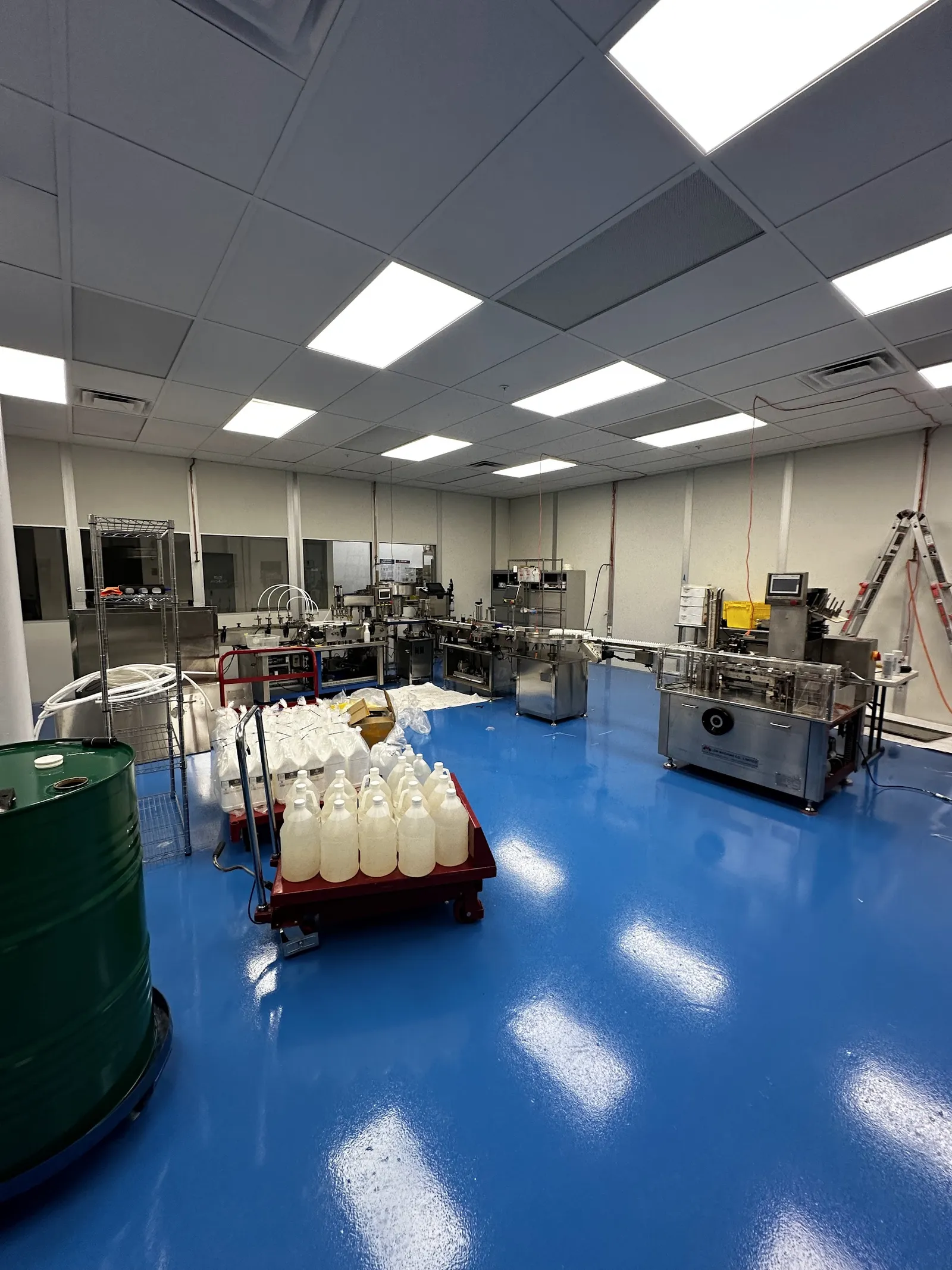
Concrete crack repair is not cosmetic work done to make a floor look tidy before the coating goes on. It is a structural decision about which cracks are finished moving and which are not, and getting that wrong is why so many coated floors in the valley have a hairline split running through an otherwise perfect surface within a year.
A coating is a thin film bonded to a slab. It does not reinforce concrete, it does not span a moving joint, and it cannot hold two pieces of a slab together. What it can do is sit over a crack that has been correctly treated and never show it again.
Why Las Vegas slabs crack the way they do
Much of the valley sits on caliche, a naturally cemented carbonate hardpan. It is hard, and it is not uniform. Where it lies shallow under one part of a slab and deeper under another, support changes across the pour, and the slab responds to that difference by cracking. This is the pattern behind cracks that run across a garage or a driveway in a line that ignores the control joints entirely.
Add to that a large daily temperature swing, which works every slab in the valley through an expansion and contraction cycle every day of the year, and exterior slabs harder than interior ones. Add drying shrinkage on newer pours, which is normal and expected, and settlement where fill was not compacted evenly. Parts of the valley also carry sulfate bearing soils, which is why local slabs are commonly specified with sulfate resisting cement, and which is worth knowing because it means the concrete you are bonding to is not always the mix you assumed.
The crack types, and what each one means
Drying shrinkage cracks. Fine, often branching, appearing within the first months of a pour and then stopping. They are the most common and the least serious. Once genuinely stable, they are routed, filled and forgotten.
Settlement and differential support cracks. Wider, usually running in a single line across the slab, often with a slight difference in level between the two sides. These are the caliche signature. They may be finished moving or they may not, and that has to be established rather than assumed.
Structural cracks. Wide, with displacement, sometimes with visible movement under load. These are outside coating scope. A coating contractor who quotes a coating over one without saying so is selling you a problem in a new color.
Joint spalling. Not a crack, but broken concrete at the edges of a control joint, usually from wheel loads over an unfilled joint. It is repaired as part of joint treatment.
Static or moving: how the question gets answered
The distinction decides the repair. A static crack can be filled rigidly, ground flush and coated over, and it will not return. A moving crack filled rigidly will simply crack the filler and then the coating, usually along exactly the same line.
Age is the first clue: a crack that appeared years ago on a slab that has been through many seasons is more likely finished than one that appeared last spring. Displacement is the second: any difference in level between the two sides means something is still moving or has moved significantly. Where there is genuine doubt, a crack gauge fixed across the crack and read over a period of weeks settles it, and on a floor where a lot rides on the answer that wait is worth it.
Concrete crack repair methods, matched to the diagnosis
Routing and filling. The crack is opened out with a crack chaser to give clean, sound sides and a consistent section, cleaned, then filled with a rigid or semi rigid material and ground flush. Opening the crack first is what makes the repair hold. Filling an unrouted hairline just bridges dirt.
Semi rigid fillers in joints. Control joints in a floor that carries wheel loads are filled with a semi rigid polyurea or epoxy that supports the joint edges against traffic while still allowing some movement. This is standard practice on industrial floors and it is the right treatment on a garage that will carry vehicles.
Flexible sealant where movement is real. A joint that genuinely moves is treated with a flexible sealant and the coating is terminated cleanly at each side rather than run across it. This leaves a visible line, and that is the honest outcome: the alternative is an invisible line for six months and a torn coating afterward.
Injection. Epoxy injection bonds a static structural crack back together. Polyurethane injection is used where water is moving through it. Both are specialized operations with their own assessment, and neither belongs in a general coating quote as an afterthought.
Spall and edge rebuild. Broken concrete is cut back to sound material, primed and rebuilt with a repair mortar compatible with the coating going over it. Compatibility matters, because a repair material that cures differently or has a different surface chemistry can flash off differently under the topcoat and show as a patch.
Control joints must be honored, not buried
Control joints exist so that shrinkage cracking happens in a straight line where somebody chose, rather than randomly. They are not defects and they do not get filled solid and coated over on a whim. In an interior floor with light traffic they are often filled and coated across. In a garage carrying vehicles, or on any exterior slab, they are treated so they can still function. That decision belongs in the proposal in writing, because it is the most common source of a homeowner being surprised by a visible line in a finished floor.
Exterior slabs move more, which is why joint treatment on a driveway coating or a patio coating is a bigger part of the specification than it is indoors.
What happens if this step is skipped
Two outcomes, both familiar. The crack telegraphs: a visible line appears through the finished coating within weeks as the filler shrinks or the crack keeps working. Or the crack reopens: the coating splits along the line, moisture gets underneath, and the edges start lifting. Either way the repair is now the cost of the crack work plus the cost of redoing the affected coating. That path is covered in recoating a failed concrete floor.
Crack work also interacts with moisture. A crack that is passing water is not a filling job, it is a drainage question first, which is why slab moisture testing belongs in the same assessment.
What a good proposal says about cracks
It identifies each crack, states whether it is being treated as static or moving, names the treatment, and says plainly whether it will be visible in the finished floor. It also states what happens if a crack that was assessed as static turns out not to be. Vague language here is the tell: “cracks will be filled” is not a specification.
Preparation and crack work happen together, and the methods are covered in concrete surface preparation. Where the floor is a garage, the whole specification is in the Las Vegas garage floor coatings guide, and the full range of work is on the services page.
Frequently asked questions
Will a floor coating hide the cracks in my slab?
Correctly treated static cracks disappear and stay disappeared. Moving cracks do not, and any contractor promising otherwise is promising something a thin film cannot do. The honest answer for a moving crack is a flexible treatment with a visible line, which is far better than an invisible line that tears open in a season.
How do you tell if a crack is still moving?
Age and displacement are the first indicators, and where there is real doubt a crack gauge fixed across the crack and read over several weeks gives a definitive answer. On a large or expensive floor that wait is worth building into the schedule, because the repair method depends entirely on the answer.
Why do cracks in Las Vegas run across the slab instead of along the joints?
Usually because support under the slab is not uniform. Caliche hardpan lies at different depths across a lot, so one part of a slab is bearing on very stiff material and another on softer fill. The slab cracks where that difference is, regardless of where the control joints were cut.
Do control joints have to stay visible after coating?
It depends on the floor. Interior floors with light foot traffic are often filled and coated across. Garages carrying vehicles and any exterior slab should have joints treated so they can still function, which usually leaves a visible line. That decision belongs in the proposal before work starts, not as a discovery afterwards.
Can you coat a slab with a structural crack in it?
Not responsibly, not until the structural issue has been assessed and addressed. A coating adds no strength and will not stop displacement. The right sequence is assessment, repair by whoever is qualified to do it, a period to confirm stability, and only then a coating.