

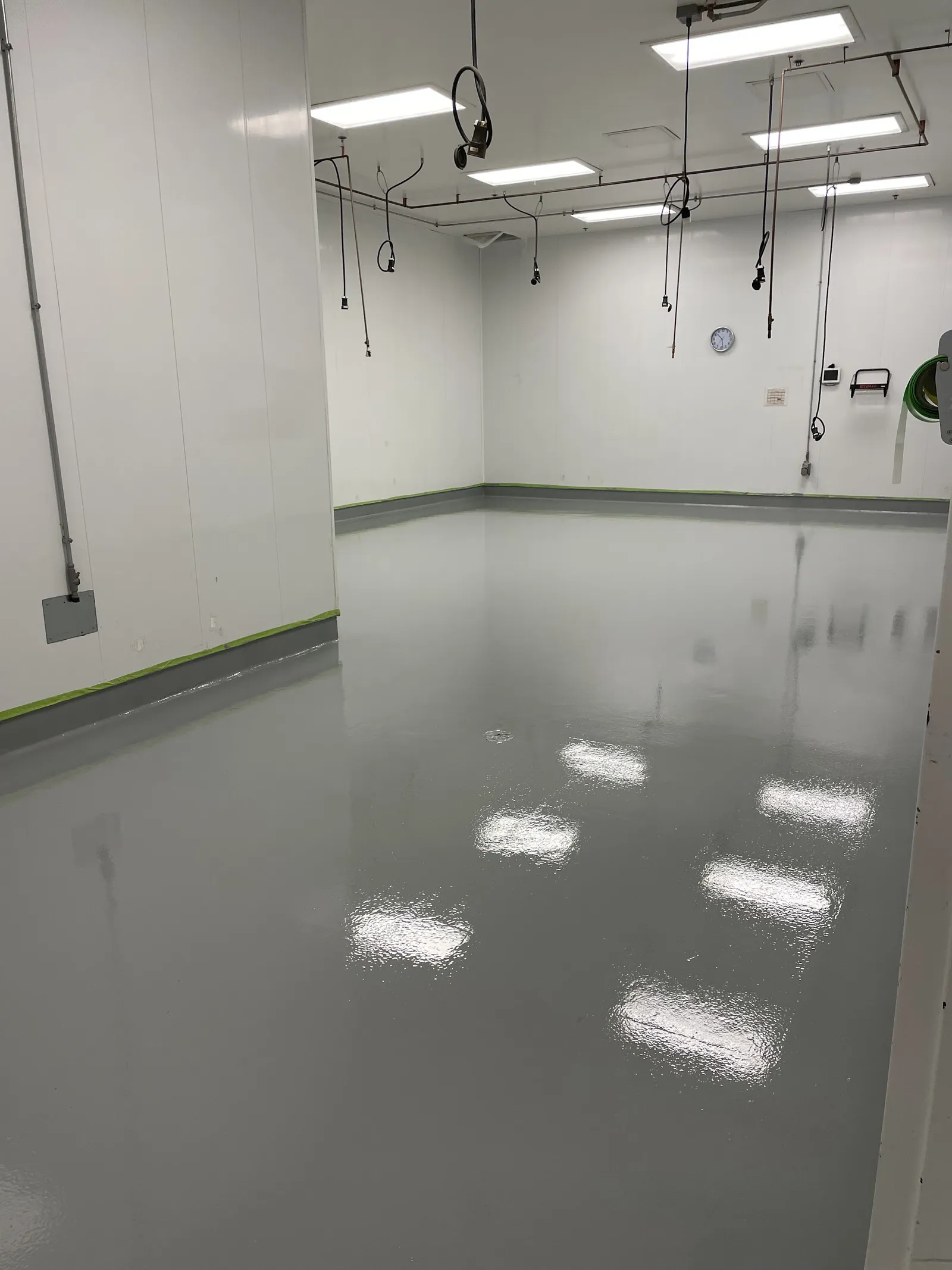
Concrete surface preparation is where most floor coatings are won or lost. Everything else in a specification, the primer, the build, the broadcast, the topcoat, is bonded to whatever the preparation left behind. If that surface is weak, the whole system is weak, regardless of how good the products are or how much the job cost.
In Las Vegas this matters more than it does in a mild climate, because a coated floor here is worked constantly by temperature swing, by sun at the door line, and by hot tires arriving off summer asphalt. Those forces find the weakest point in the assembly. Nine times out of ten that point is the bond.
What concrete surface preparation is actually removing
Fresh concrete does not have a uniform surface. Finishing pushes water and fine particles to the top, and what sets there is laitance, a weak layer of cement paste and fines sitting over sound concrete. It looks like the floor. It is not the floor. It has a fraction of the strength of the material underneath, and anything bonded to it can only be as strong as that layer.
Power troweling, which is standard on tract housing and commercial slabs across the valley, makes the problem worse in two ways. It produces more laitance and it closes the pore structure, so there is nowhere for a primer to key into even after the weak material comes off. That is why a slab that looks smooth, hard and clean is often the worst candidate for a coating and the best candidate for a failure.
Preparation also has to remove everything else: old coatings, curing compounds, sealers, adhesive, paint, and contamination. Oil and transmission fluid soak in and cannot be washed out, only ground past.
Profile, and why the number in the data sheet exists
The International Concrete Repair Institute publishes a numbered scale of concrete surface profiles, running from a barely textured surface up to a heavy exposed aggregate finish. Every coating manufacturer names the profile their product requires, because film thickness and profile have to match. Too smooth and the coating has nothing to grip. Too aggressive for a thin system and the profile telegraphs through the finish or the peaks are left starved of material.
A contractor who cannot tell you what profile they are targeting has not read the data sheet for the product they are selling. It is a fair question and it separates the trade quickly.
The three methods that work, and the one that does not
Diamond grinding. Rotating heads carrying diamond segments cut the surface. Segment hardness has to be matched to the concrete, and this is the part inexperienced crews get wrong: soft bond tooling on soft concrete glazes over and stops cutting, hard bond tooling on hard concrete wears the segments away for very little progress. Grinding handles most residential work, produces a moderate profile, and is the most controllable method for edges and detail.
Shot blasting. Steel shot is thrown at the surface at speed and recovered with the debris in a closed loop. It is fast over open area, leaves a deeper and more uniform profile, and is the usual choice on large or hard floors. It does not reach edges, corners or anything within a few inches of an obstruction, so it is always paired with grinding for the perimeter.
Scarifying. Toothed cutters chip material away aggressively. It is a removal tool rather than a profiling tool, used for thick coatings, heavy build ups or knocking down high spots, and it always needs grinding afterwards to clean up the very rough profile it leaves.
Acid etching. Not equivalent, and the shortcut behind a large share of the failures we are called to look at. It removes some laitance chemically but leaves residue and salts unless it is neutralized and rinsed thoroughly, and rinsing means water on a floor that then has to dry. It does not produce a measurable, repeatable profile. On a garage with a floor drain it also creates a disposal problem. If a bidder proposes it, ask what profile they are targeting and how they intend to verify it.
Verification, before anything is opened
Three checks are worth insisting on once the floor is prepared. Visual comparison of the profile against the reference standard the manufacturer names. A dust free surface, vacuumed rather than blown, because blowing moves dust rather than removing it and it lands back in your primer. And on any floor where the substrate is doubtful, a pull off adhesion test on a trial patch, which is a small, cheap piece of work that answers the whole question before a full system goes down.
Moisture testing belongs in this same window, after preparation and before priming, because grinding opens the surface and changes what a test reads. What to test for and what the readings mean is covered in concrete slab moisture testing.
The parts nobody photographs
Preparation is not only the open field. Cracks have to be routed and filled, control joints have to be treated so they can still move, and spalled edges have to be rebuilt, all of which is covered in crack repair before coating. Perimeters need a cut line so the coating terminates cleanly rather than feathering. Thresholds, drains, anchor bolts and column bases all need detailing. Where an old coating is coming off, the reason it failed has to be identified rather than assumed, which is the subject of recoating a failed concrete floor.
Dust, containment and why it costs what it costs
Grinding and blasting concrete generates respirable crystalline silica, and controlling it is not optional. Equipment runs with shrouds and vacuums rated for the work, sheeting seals the space off from the rest of the building, and negative air is used where the area is occupied. A crew grinding a garage with no extraction is telling you something about the rest of their standards.
Containment is also why preparation dominates the labor line in a proper quote. It is the slowest, dirtiest and most equipment intensive part of the job, which is exactly why it is the first thing cut by a bid that has to come in low. What that trade off actually buys and costs is set out in what drives coating cost.
What to ask before you sign
Ask which method they will use and why it suits your slab. Ask what surface profile they are targeting and how they will verify it. Ask how dust will be contained. Ask what happens to the perimeter, the joints and any existing coating. Ask whether a trial patch and adhesion test are included on a floor with any doubt about it. The answers to those five questions predict the outcome better than the brand of resin on the invoice.
Our full range is on the services page, the garage specification is in the Las Vegas garage floor coatings guide, and larger floors are handled through commercial epoxy flooring.
Frequently asked questions
Is acid etching ever acceptable before a floor coating?
Not as a substitute for mechanical preparation on a floor that has to carry traffic. It removes some laitance but leaves residue, does not produce a measurable profile, and cannot deal with old coatings or contamination. Where a manufacturer permits it at all, it is for light duty systems on clean bare concrete, and it still has to be neutralized and rinsed thoroughly.
How do I know the profile is right?
Ask which profile number the manufacturer requires and ask to compare the prepared floor against the reference standard for it. This is a normal part of a professional installation. On any floor where the substrate is questionable, a trial patch with a pull off adhesion test answers it definitively before the whole system is committed.
Can you grind a garage floor without filling the house with dust?
Yes. Equipment runs with shrouds connected to vacuums rated for concrete dust, and the work area is sealed off from the rest of the building. Respirable silica is the reason this is done properly rather than an inconvenience, and a crew arriving with no extraction should not be grinding an attached garage.
What happens to oil stains?
Surface oil is degreased. Oil that has soaked into the concrete has to be ground past, and if it has penetrated deeply the affected area may need more aggressive removal and a primer chosen for contaminated substrates. Coating over an oil saturated patch produces a spot that never bonds, and it is usually the first place the floor lets go.
How long does preparation take on a typical garage?
Less time than most homeowners expect, but it is the part of the schedule that varies most, because it depends on what has to be removed before profiling can start. A bare, sound slab is quick. A slab with an old coating, adhesive residue or heavy contamination can double the preparation phase, which is why the assessment happens before the schedule is promised.