

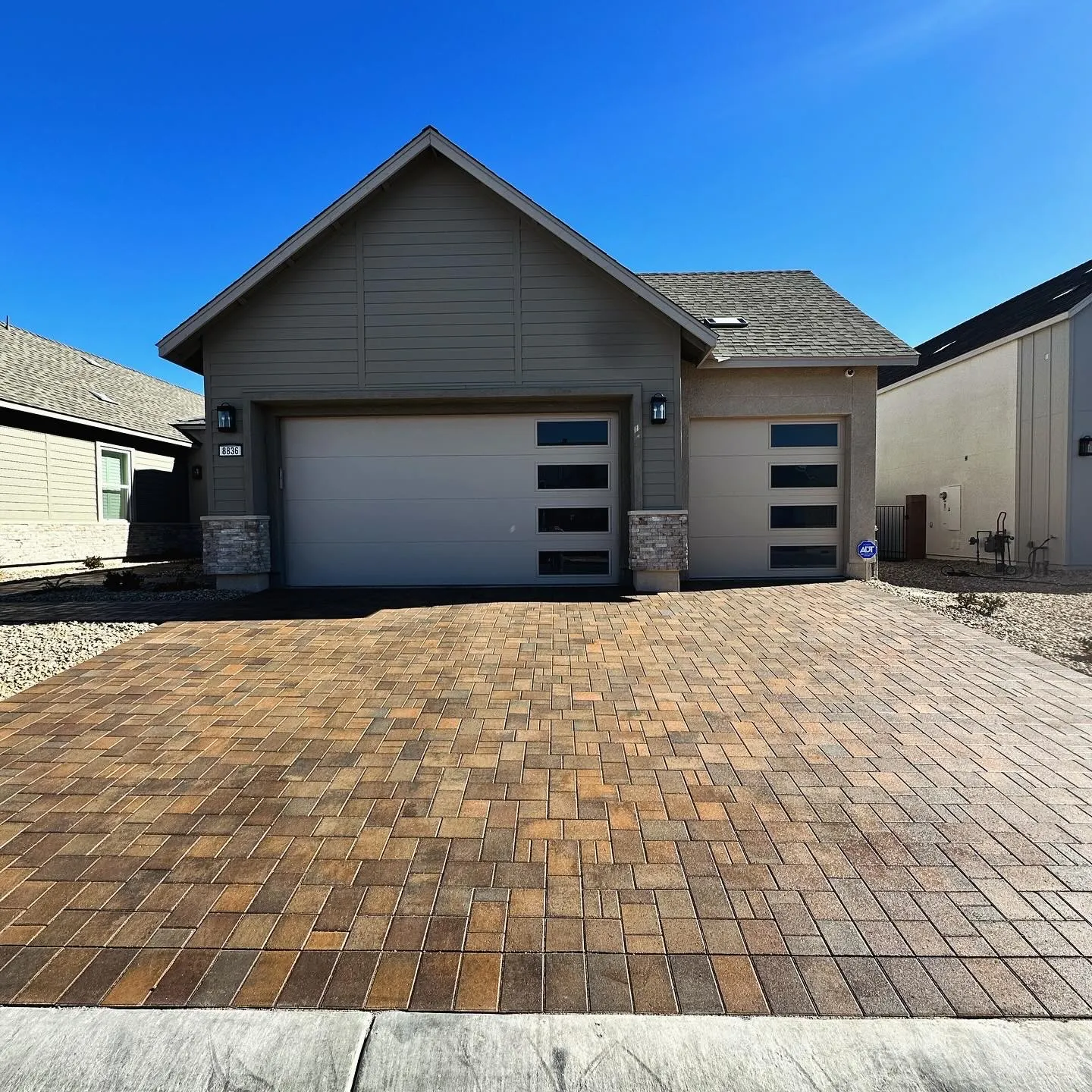
A driveway coating Las Vegas homeowners choose has to survive the hardest conditions on the property. No shade, full sun from mid morning until it goes down, the largest temperature swing of any slab on the lot, vehicle loads, and tires arriving straight off summer asphalt and parking there.
Interior floors forgive a lot. A driveway forgives nothing, and a specification that works fine in a garage will fail outside within a couple of seasons.
Driveway coating Las Vegas conditions: what it is fighting
Surface temperature, not air temperature. An unshaded slab in direct sun runs well above ambient, and it stays hot long after the sun is off it. That matters twice: during installation, when working time collapses, and in service, when the coating spends months of the year at temperatures near the upper end of what it was designed for.
Thermal movement. The slab expands through the day and contracts sharply on a clear desert night. Concrete and coating move at different rates, so every cycle works the bond line, and the joints and edges take the most of it. This is the mechanism behind edge lifting on exterior work, and it is why joint detailing outdoors is not the same job it is indoors.
Ultraviolet exposure, all day. Standard epoxy is not UV stable and will amber and chalk. On a driveway there is nowhere for that to hide. The topcoat has to be aliphatic, and on an exterior slab it is worth carrying UV stable chemistry through the system rather than only at the top, as explained in ultraviolet stability and color hold.
Hot tire pickup, worse than in a garage. A tire that has been running on hot asphalt arrives hotter than one that crossed a cool garage, and it sits on a slab that is already hot. Softening and plasticizer migration both accelerate. This is the failure that shows up first on an underspecified driveway.
Vehicle fluids and grit. Oil, fuel, coolant, brake fluid and battery acid all land on a driveway, and desert grit dragged in on tires acts as an abrasive under every turn of the wheel.
Specification consequences
Everything tightens compared with an interior floor.
The build has to be genuine, with a primer, a body coat and a topcoat rated for vehicle traffic, not a thin decorative film. Thickness and layering are covered in coating thickness and film build.
Texture matters twice outdoors. A broadcast or aggregate texture gives slip resistance when the surface is wet, which on a sloped driveway during a monsoon downpour is a real safety question rather than a preference. Texture also breaks up direct reflection, and a lighter color with texture is noticeably more comfortable underfoot than a dark smooth one on a July afternoon.
Joints get treated, not bridged. An exterior slab moves enough that a rigid fill across a working joint will crack, so joints are filled with a material that can move and the coating is terminated cleanly at each side. Crack assessment and joint treatment are covered in crack repair before coating.
The edges and the apron need attention. A driveway edge that is spalled or undercut has to be rebuilt before coating, and the transition at the street and at the garage threshold has to be detailed or it becomes the first failure point.
Preparation outdoors is also harder than indoors, and it is where exterior bids diverge most. An old driveway usually carries a curing compound or a sealer from when it was poured, years of tire rubber, oil at the parking spots, and a surface that has already lost some of its cement paste to weathering. All of that has to come off mechanically before profiling, and containment on an open exterior slab means managing dust and slurry in wind rather than in a sealed room.
Coating, sealing or resurfacing
Three different answers to three different problems, and they get confused constantly.
A penetrating sealer soaks into the concrete and leaves no film. It reduces water and salt absorption and changes the appearance very little. It does not cover cracks, does not change color and cannot be made to look like a finished floor. It is a maintenance product for sound concrete.
A coating is a film bonded to the surface, which is what gives you color, texture and a cleanable finish. It requires proper preparation and it requires a sound slab underneath.
A resurfacing overlay is a cementitious layer placed over the existing slab to correct surface condition, restore a worn or spalled surface and provide a new wearing course. It is the answer when the concrete surface itself is too far gone to coat directly, and it can then be sealed or coated in turn. Systems and options are on the driveway coatings page.
Getting this choice right is most of the decision, and it depends on the slab rather than on preference.
Drainage, irrigation and the slab edge
Driveways slope, and where the water goes decides how long the coating lasts at the low end. Water pooling at a threshold, at the apron or against a garage door seal keeps that area wet far longer than the rest, and continuous wetting at an edge is how water gets under a slab.
Irrigation running alongside the driveway does the same thing more quietly. Drip lines and spray heads against the slab edge feed moisture under the concrete, which shows up first as the white bloom covered in efflorescence and white haze on coated concrete and later as blistering. Moving a drip line is the cheapest repair available on any concrete project.
Installing one without fighting the weather
Exterior work in summer is scheduled around the sun, not around the working day. Crews start early, work the shaded side first where there is one, and stop when the slab temperature says stop. Wind is the other exterior variable: the valley moves a lot of fine dust, and grit landing in a wet coat is a permanent finish defect. Scheduling is covered in choosing when to schedule a floor coating, and local conditions on the north side of the valley in our North Las Vegas page.
Return to service is longer outdoors than most people expect, because vehicles are heavier than feet and hot tires are the specific risk. Get both numbers in writing. The full range of exterior and interior work is on the services page.
Frequently asked questions
Will an epoxy driveway coating survive Las Vegas summer?
An epoxy on its own will not, because it is not ultraviolet stable and will amber and chalk in full sun. A system built for exterior use will: a primer, a body coat, a texture for slip resistance and an aliphatic ultraviolet stable topcoat rated for vehicle traffic. The distinction is the specification, not the climate.
Why is hot tire pickup worse on a driveway than in a garage?
Because the tires are hotter and the slab is hotter. A tire coming off summer asphalt arrives hot and parks on concrete that has been in the sun all day, so the coating is at its softest exactly where the load is highest. Full cure before vehicles return and a topcoat rated for vehicle traffic are what prevent it.
Is a coating or a sealer better for a driveway?
They do different jobs. A penetrating sealer reduces absorption and leaves the appearance nearly unchanged, which suits sound concrete you are happy with. A coating gives color, texture and a cleanable surface but needs full preparation and a sound slab. If the concrete surface itself is worn or spalled, a resurfacing overlay comes first.
Will a coated driveway be slippery when wet?
Not if it is specified with texture. A broadcast or aggregate texture provides slip resistance when wet, which matters on a sloped driveway during a monsoon downpour. A smooth high gloss film on an exterior slope is the wrong choice, and it is worth stating the requirement in the proposal rather than assuming it.
Can a cracked driveway be coated?
It depends on why it cracked and whether it is still moving. Static cracks are routed, filled and coated over successfully. Moving cracks need a flexible treatment and stay visible. A slab with structural cracking or significant displacement needs that addressed first, because a coating adds no strength and will simply split along the same line.