

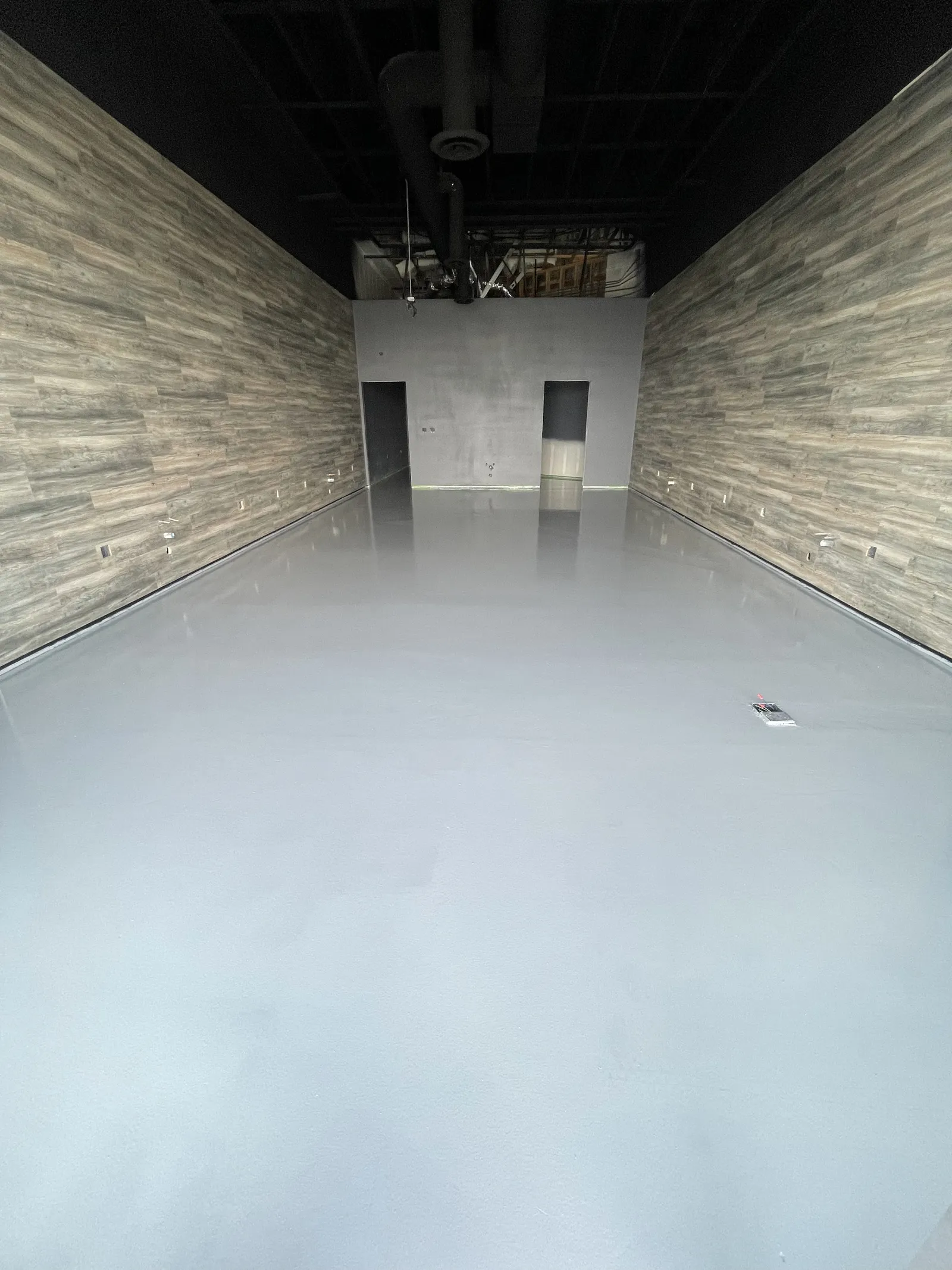
Concrete floor recoating goes wrong for one predictable reason: somebody puts a new system over an old one without establishing why the old one failed. The new floor then fails the same way, on the same schedule, and the homeowner concludes that coatings do not work in this climate.
They work. What does not work is treating a failed floor as a surface to be covered rather than a diagnosis to be made.
Read the failure before you price the fix
Failed coatings tell you what happened if you look at them properly. Five patterns cover almost everything we see in the valley.
Sheet delamination. The coating lifts in large pieces and the underside is clean, with a thin layer of pale concrete paste stuck to it. That is a preparation failure: the system was bonded to laitance rather than to sound concrete. The tell is the concrete on the back of the peeled piece.
Blistering. Domes across the field, sometimes fluid underneath, appearing weeks or months after installation. Almost always moisture moving up through the slab under a film it cannot pass. The other candidates are trapped solvent and material applied too thickly, and testing the exposed slab afterwards settles which.
Ambering and chalking. The floor is intact but yellowed and dull, usually worst where sun reaches it. That is ultraviolet degradation of an epoxy that was never protected by an ultraviolet stable topcoat, and it is the one failure that is purely a specification error. The chemistry is covered in ultraviolet stability and color hold.
Hot tire pickup. Crescent shaped patches lifted where tires sat. Under cured material, a topcoat not rated for vehicles, weak bond, or vehicles returned before full cure. Often all four at once.
Interlayer separation. The topcoat comes off the body coat but the body coat is still tight to the slab. That is a recoat window problem: the next coat went on outside the period in which it could chemically bond and nobody abraded the surface to compensate. The defects that show up in fast curing systems are covered in our guide to polyaspartic coating mistakes.
Test, do not assume
Two cheap checks answer most questions. A cross hatch or pull off adhesion test on the existing coating tells you how well what is there is actually holding, in numbers rather than impressions, and it should be run in several places because a floor rarely fails uniformly. And once any area is exposed, the bare slab gets tested for moisture, because a moisture problem that took out the first system will take out the second one just as reliably. Method and interpretation are in slab moisture testing.
A solvent wipe on an unknown existing coating is worth doing too, because it gives a rough indication of what chemistry you are dealing with before anything is specified over it.
Full removal or abrade and overcoat
This is the decision the whole project turns on, and it is driven by the adhesion results rather than by budget.
Full removal is required when the existing system is delaminating, when moisture is the cause, when the material is unknown and adhesion is poor, or when contamination sits under it. Everything comes off mechanically, back to sound concrete, and the floor is then treated as a bare slab. It is the more expensive path and it is the one that produces a floor you can stand behind.
Abrade and overcoat is legitimate when the existing coating is genuinely well bonded, when the failure is confined to the wear layer, when the chemistry is known and compatible, and when adhesion testing supports it. The existing surface is abraded to give mechanical key, cleaned, and recoated. It is faster and less disruptive, and it is only honest when the tests back it.
Partial repair almost never works as a standalone answer on a residential floor. Patching failed areas within a field that is itself marginal buys a few months and a visible patchwork. It is reasonable as a stopgap on a commercial floor waiting for a shutdown window, and it should be described as a stopgap when it is sold as one.
Removal is the hard part
Taking a bonded coating off is more work than putting one on. Thick or tough systems come off with a scarifier and are then ground to a proper profile. Thinner films come off with grinding alone, using tooling matched to the material rather than to the concrete, which is a distinction inexperienced crews miss and then wonder why their segments are glazing over. Shot blasting works on large open areas once the bulk is gone.
Then the floor still has to be profiled properly for the new system, which means the whole preparation sequence runs after removal rather than instead of it. That is set out in concrete surface preparation. Dust control matters more here than on a bare slab, because you are removing both concrete and coating.
Concrete floor recoating: specify the replacement around what failed
The new specification has to answer the diagnosis, not repeat the last one at a higher price. If moisture caused it, the new system includes a mitigating primer or a moisture tolerant build. If ultraviolet exposure caused it, the topcoat changes to an ultraviolet stable chemistry. If preparation caused it, the profile is verified this time and a trial patch is worth running first. If hot tire pickup caused it, the topcoat is rated for vehicle traffic and the return to service time is stated and enforced.
And if the diagnosis is that the slab itself is the problem, through movement, structural cracking or persistent water, that has to be said before anything is sold. What the replacement scope does to a quote is set out in what drives coating cost.
What a remediation proposal should contain
The diagnosis in plain language, with the evidence behind it. The adhesion test results and where they were taken. The moisture readings from the exposed slab. The removal method and how far it goes. The new system named coat by coat. What the warranty covers on a remediation job, which is often narrower than on a bare slab and should say so honestly, as covered in floor coating warranties.
Residential remediation runs through the services page, and larger or occupied floors through commercial epoxy flooring, where the shutdown window usually drives the sequence.
Frequently asked questions
Can you coat over an existing epoxy floor?
Only when adhesion testing shows the existing system is genuinely well bonded, the chemistry is known and compatible, and the failure is confined to the wear layer. Then the surface is abraded for mechanical key and recoated. Coating over a system that is letting go anywhere just adds weight to a failing bond and hides the evidence.
How do I know why my floor failed?
Look at the failure pattern and then test. Sheet delamination with pale concrete on the back of the peeled material is a preparation failure. Domed blisters point to moisture. Yellowing and dulling in the sun path is ultraviolet damage. Crescents where tires sat are hot tire pickup. Adhesion tests and a moisture reading on the exposed slab confirm which.
Is removing an old coating expensive?
It is usually the largest single line in a remediation quote, because taking a bonded film off concrete is slower than applying one and it generates a great deal of dust that has to be contained. It is also the item most often left out of a low bid, which is why a remediation quote that looks similar to a new floor quote deserves a question.
Will the new coating fail like the last one?
Only if it is specified the same way. A replacement built around the diagnosis is a different specification: a mitigating primer where moisture was the cause, an ultraviolet stable topcoat where sun was, a verified profile where preparation was, a vehicle rated topcoat and an enforced cure period where tire pickup was. A replacement built around the price is the same floor again.
Can part of a failed floor be repaired instead of all of it?
Sometimes, and it should be described honestly as a stopgap. On a commercial floor waiting for a shutdown window it is a reasonable interim measure. On a residential garage it usually produces a visible patchwork that fails again at the boundaries, and the money is better spent once on doing the whole floor properly.