

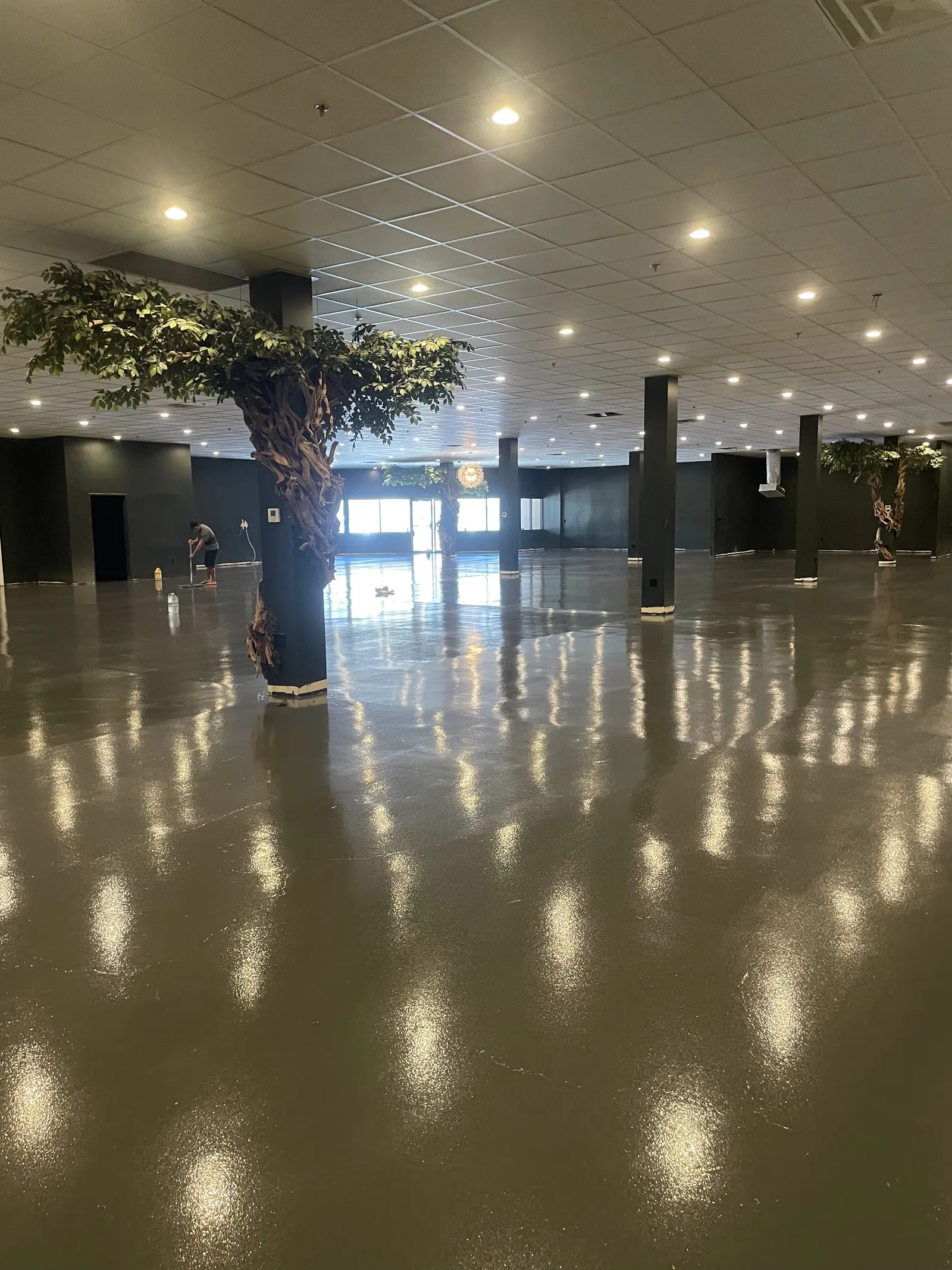
Floor coating installation in Las Vegas is possible every month of the year, and the season changes the job in ways that belong in the schedule and the proposal rather than being discovered on the day. Coating chemistry is temperature driven, and the temperature that matters is the slab’s, not the forecast’s.
Two crews can install the same system on the same floor in July and in January and produce two different results, not because one is better but because one planned for the conditions and the other assumed the data sheet was describing the room they were standing in.
Substrate temperature, not air temperature
Every product data sheet gives a temperature range, and the number that matters is the temperature of the concrete. Concrete has enormous thermal mass. An uninsulated garage slab lags the air by days, so a slab that spent a cold week at night temperatures is still cold on a warm afternoon, and a slab that baked through July is still warm at ten at night.
The practical consequence runs both ways. Too cold and the reaction slows, cure extends well past the published time, and some systems will not develop full properties at all. Too hot and the reaction accelerates, working time collapses, and the crew runs out of time to wet out the surface, broadcast into it and pull a clean edge before the material sets.
Anyone can check the substrate with an infrared thermometer, and it costs nothing to ask a crew whether they have one out on the day.
Summer: a working time problem
The rule of thumb across two part reactive coatings is that the pot life shortens sharply as temperature rises, and on a hot valley slab the working window can be a fraction of what the data sheet suggests. Fast systems such as polyaspartics are affected most, because their working time is short to begin with. On a hot afternoon it can be measured in minutes.
Competent crews adapt rather than push through. Smaller batches. Earlier starts, often before dawn on exterior work. More hands so material is placed and broadcast before it goes off. Cooling the space where it can be closed up. Splitting a large floor into more sections with planned wet edges.
Exterior work in summer adds direct solar gain on top of everything else. An unshaded driveway slab in July runs far above air temperature, which is why driveway coating in Las Vegas heat is scheduled around the sun rather than around the working day.
Monsoon: a dew point problem
Late summer brings humidity spikes to the valley, and humidity matters through one rule: the substrate has to stay above the dew point during application and through cure. The common industry practice is to keep it at least five degrees Fahrenheit above. Below that, moisture condenses on the surface, and a film applied onto or curing over condensation can haze, blush or lose adhesion.
The insidious version is not the obvious one. A slab that is comfortably above dew point at two in the afternoon can drop below it overnight while the coating is still curing. That is why a crew should be reading dew point for the cure window, not for the moment of application, and why some jobs get conditioned overnight rather than left to chance.
Winter: a cure problem
Valley winters are mild by most standards and still cold enough to matter on an uninsulated slab. Cure slows, return to service times extend, and recoat windows stretch, which affects the whole sequence when a system needs its next coat within a defined period.
The fixes are straightforward when planned: temporary heat, closing the space, sequencing so the slab has warmed before the first coat goes down, and choosing a product family rated for lower temperatures where the schedule cannot move. All of it belongs in the proposal, because heaters and an extra day are scope, not goodwill. What else moves a quote is covered in what drives coating cost.
The easiest months for floor coating installation in Las Vegas
Spring and autumn are the straightforward windows in this valley. Slab temperatures sit comfortably inside most product ranges, humidity is low without being extreme, and the day is long enough to work without racing the heat. If a project has no urgency attached to it, those are the months to aim for, and they are also the months the trade books up first.
That said, the season is never the reason a floor fails. Preparation, moisture and cure discipline are. A well planned July job beats a careless March one every time. Preparation is covered in concrete surface preparation and the moisture side in slab moisture testing.
Occupied buildings add a second calendar on top of the weather one. A retail floor, a shop or a working facility usually has to be coated at night or over a shutdown, and night work in summer is genuinely easier because the slab has given up some of its heat, while night work in winter is harder for exactly the same reason. Where the space can be conditioned, that removes most of the seasonal argument and turns the question into a logistics one. Larger floors and occupied spaces are handled through commercial epoxy flooring, where the shutdown window is usually the binding constraint rather than the weather.
Crew size is the other lever people forget. A short working window is survivable if there are enough hands to place, broadcast and back roll a section before it starts to set. The same floor with two people instead of four in the same July conditions is a floor with visible lap lines in it. When a summer quote looks unusually cheap, crew size is worth asking about directly.
Return to service changes with the season too
Cure times published by manufacturers are stated at a reference temperature. The same floor coated in January and in July has different foot traffic and vehicle return times, and the vehicle number is the one that causes trouble when it is wrong, because parking on a floor that has not reached full cure is the main cause of hot tire pickup on an otherwise sound installation.
Ask for both numbers, in writing, for the season the work is actually happening in. The garage specification that sits behind those numbers is in the Las Vegas garage floor coatings guide, and how a job runs from assessment to handover is on the process page.
Planning around your own calendar
The other half of scheduling is you. A garage has to be empty, and a household needs somewhere to put its contents and its vehicles for the duration. An occupied commercial space may need the work at night. A homeowners association may need to approve anything visible from the street before a date can be fixed. All of that lengthens the lead time rather than the job, and it is worth starting earlier than feels necessary. The homeowner side of it is set out in preparing a garage before installation, and the full range of work is on the services page.
Frequently asked questions
What is the best time of year for a floor coating in Las Vegas?
Spring and autumn are the easiest windows, because slab temperatures sit inside most product ranges and humidity is moderate. Summer and winter both work with planning: summer needs smaller batches, earlier starts and sometimes cooling, and winter needs warmth and a longer cure allowance. Season is a scheduling factor, not a quality one, provided it is planned for.
Can a garage floor be coated in July?
Yes, and it happens constantly here. The adjustments are real though: hot concrete cuts working time sharply, so crews mix smaller batches, start early and bring more hands. What you should not accept is a summer job scheduled as if it were a spring one. Ask how the crew is handling substrate temperature before you book the date.
Does monsoon humidity affect a coating?
It can, through the dew point. The slab must stay above the dew point during application and through cure, and the risk is often overnight rather than at the moment of application. A film curing through a period of condensation can haze or lose adhesion. Crews that read dew point for the whole cure window rather than for the application hour avoid it.
Is winter installation a bad idea in the valley?
No, it just takes longer. Cold slabs slow the reaction, extend cure and stretch recoat windows. Temporary heat, closing the space and sequencing so the slab has warmed first all solve it. The cost is an extra day and equipment, which should appear in the proposal rather than as a surprise.
How far ahead should I book?
Further than the installation itself suggests, because the lead time is driven by everything around it: the assessment, any crack or moisture remediation the assessment finds, association approval where the work is visible from the street, and emptying the space. Spring and autumn also fill up first, so a project with a fixed date is worth starting months rather than weeks ahead.