

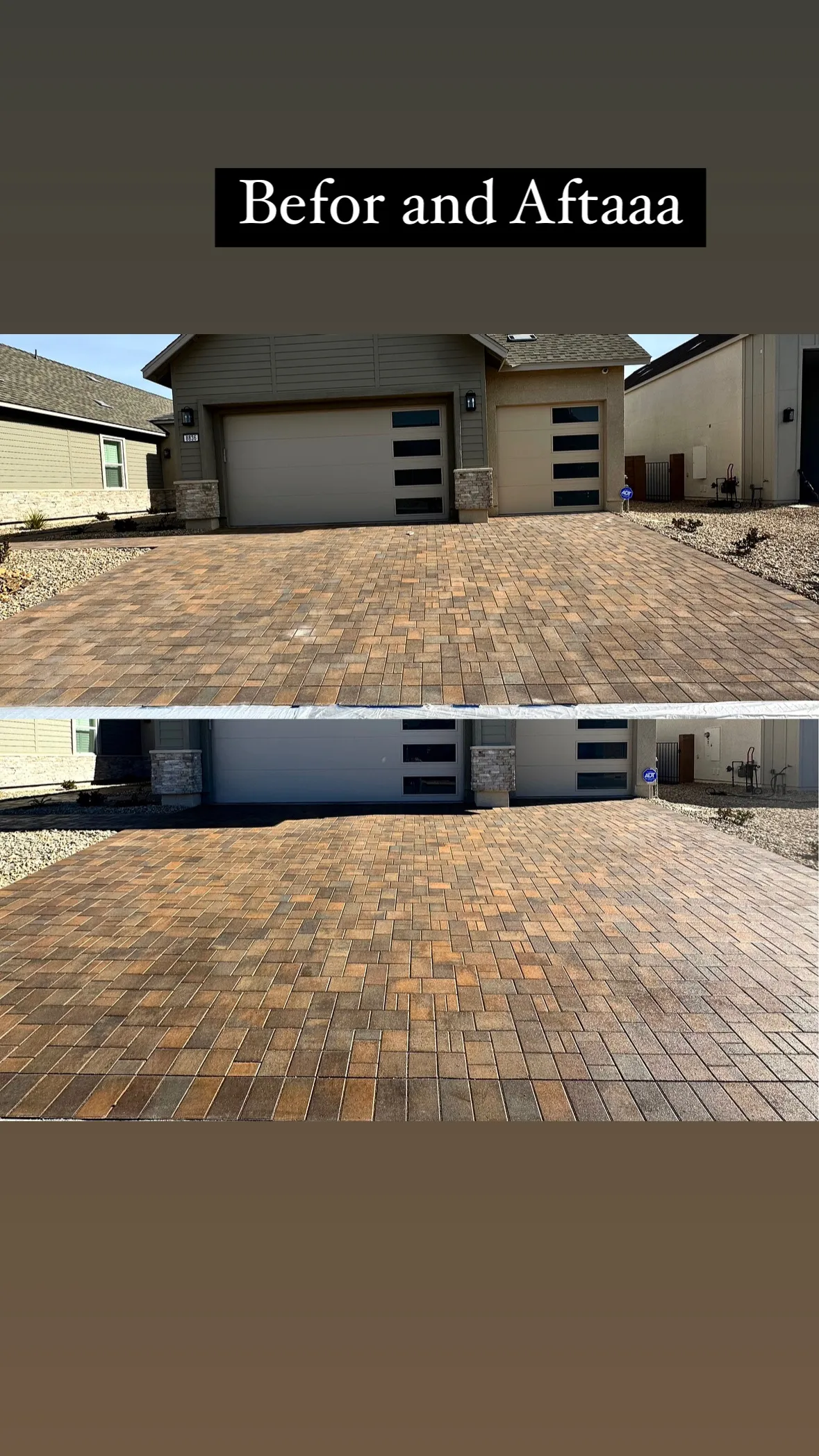
Efflorescence on concrete is the chalky white bloom that appears on a slab, along a joint, at a slab edge or under a coating, and in the Las Vegas valley it turns up far more often than people expect in a place with this little rainfall. It is not mold, it is not the coating breaking down, and wiping it away does not deal with it.
It is a symptom, and what it is a symptom of decides whether your floor has a problem or just needs cleaning.
What efflorescence on concrete actually is
Concrete contains soluble salts, mostly calcium compounds, left over from the cement and sometimes contributed by the aggregate, the mix water or the ground underneath. When water moves through the concrete it dissolves those salts and carries them along. When that water reaches a surface and evaporates, the salts stay behind as a white crystalline deposit.
Two things follow from that description and both are important. Efflorescence requires moisture moving through the slab, so its presence is direct evidence that water is moving. And it forms where evaporation happens, which is why it appears at surfaces, edges and joints rather than in the middle of a sound sealed slab.
Trade practice distinguishes primary efflorescence, which appears on new concrete as it cures and dries, from secondary efflorescence, which appears later on a slab that is taking on water from somewhere. Primary efflorescence is normal and usually stops. Secondary efflorescence is a message about a water source and it should be read that way.
Where it shows up in this valley
Pool decks and the slab immediately around water, where splash out and evaporation run all summer. Patios and driveways where irrigation lines and spray heads put water at or under the slab edge. Garage slab edges backing onto landscaping. Any slab that took monsoon runoff because grading or a downspout puts water against it. And new pours, where it is primary and expected.
Hard water adds a complication worth naming. Southern Nevada water is high in dissolved minerals, so evaporation of tap or irrigation water sitting on a surface leaves its own white mineral deposit that looks similar and is not efflorescence. The distinction matters because the mineral deposit is a cleaning problem on top of the floor, while efflorescence is a moisture problem coming through it.
Telling the two apart
Location is the first clue. Deposits that follow a joint, a crack, a slab edge or a rising damp line are coming through the concrete. Deposits in a ring where a puddle sat, or in a fan under a sprinkler head, are surface mineral residue.
Behavior is the second. Surface mineral deposits clean off and stay off if the water stops landing there. Efflorescence returns after cleaning as long as moisture keeps moving through the slab, which is the definitive test and does not require any equipment.
The third check is the one that answers the question properly: measure the slab. A plastic sheet screening test and, where it matters, an in situ relative humidity reading tell you whether moisture is genuinely moving through the concrete. That is set out in slab moisture testing.
What it means before a coating goes down
Efflorescence on a bare slab before installation is useful information, not a disqualification. It says water is moving, so the moisture reading matters more than usual and the specification may need a mitigating primer or a more tolerant system. It also has to be removed physically, because salt crystals on the surface are a bond breaker: a coating applied over them is bonded to loose crystals rather than to concrete.
Removal is part of mechanical preparation. Grinding takes the deposits and the weak surface with them, which is one more reason acid washing is not a substitute for preparation. An acid wash dissolves visible deposits, then puts more water into the slab and leaves its own residue, and it can leave the surface looking clean while the actual problem is untouched. The proper sequence is in concrete surface preparation.
There is one more preparation consequence worth understanding. Water moving through concrete does not only carry salts, it raises the alkalinity at the surface it reaches. High surface pH attacks the adhesion of some resin systems directly, so a slab with a history of efflorescence is a slab worth pH testing as well as moisture testing. It is a quick check with an inexpensive kit and it occasionally changes which primer is specified, which is much better learned before the material is ordered.
When it appears under or through a coated floor
This is the serious version. White haze under a coating, cloudy patches that were not there at installation, or deposits pushing up at joints and edges all point to moisture moving up into a system that cannot pass it. Left alone it commonly progresses to blistering or delamination, because the same water that carried the salts is also building pressure under the film.
Cleaning the top of the floor does nothing here, because the deposit is under or within the film. The honest response is diagnosis: find the water source, measure the slab, and decide whether the system can stay. That path is covered in recoating a failed concrete floor.
Joints deserve particular attention here, because they are the easiest path for water to reach the surface and therefore where the deposits appear first. Efflorescence tracking along a control joint on an exterior slab is telling you that water is getting under the slab and rising through the joint, not that the joint sealant has failed cosmetically. Resealing the joint without addressing the water simply moves the deposit somewhere else, usually to the next joint over.
Fixing the source, which is usually outside
Most secondary efflorescence in valley homes traces back to water management rather than to the concrete. Move drip lines and spray heads away from the slab edge and check what the emitters are actually wetting. Correct grading so runoff falls away from the slab rather than toward it. Extend downspouts. Repair irrigation leaks, which are easy to miss underground in a yard designed to look dry. Where a pool deck is involved, manage splash out and check the deck drainage.
Those fixes cost little compared with a floor. Where a coated surface is affected, the surfaces most often involved are the patio, the driveway and the pool deck, which is where water and concrete meet most often on a residential lot.
Frequently asked questions
Is efflorescence damaging my concrete?
The deposit itself is not structural damage. What it indicates can be. Water moving continuously through a slab can carry salts, raise surface alkalinity, break the bond of a coating and, over long periods, contribute to surface deterioration. Treat the bloom as a reading rather than as the problem.
Can I just scrub the white haze off?
You can remove what is on the surface, and it will come back as long as moisture keeps moving through the slab. That return is actually the useful diagnostic: deposits that stay away were surface mineral residue from hard water, and deposits that come back are efflorescence with a water source behind them.
Should I acid wash the slab before coating?
No, not as preparation. An acid wash removes visible deposits, adds water to a slab that already has a moisture question, leaves residue unless it is thoroughly neutralized and rinsed, and produces no measurable surface profile. Mechanical grinding removes the deposits and the weak surface layer together and gives the coating something to bond to.
Why is there white haze under my epoxy floor?
Because moisture is moving up into the coating from the slab and depositing salts at the interface. It is an early warning that usually progresses to blistering or delamination. Cleaning the surface will not reach it. The slab needs testing and the water source needs finding before any decision about the floor is made.
Does new concrete always do this?
Often, and on a new pour it is usually primary efflorescence: the slab drying out and bringing its own salts to the surface. It generally stops as the concrete dries. It is still removed mechanically before coating, and it is one more reason a new slab gets a moisture reading rather than a calendar estimate before anything is applied.