

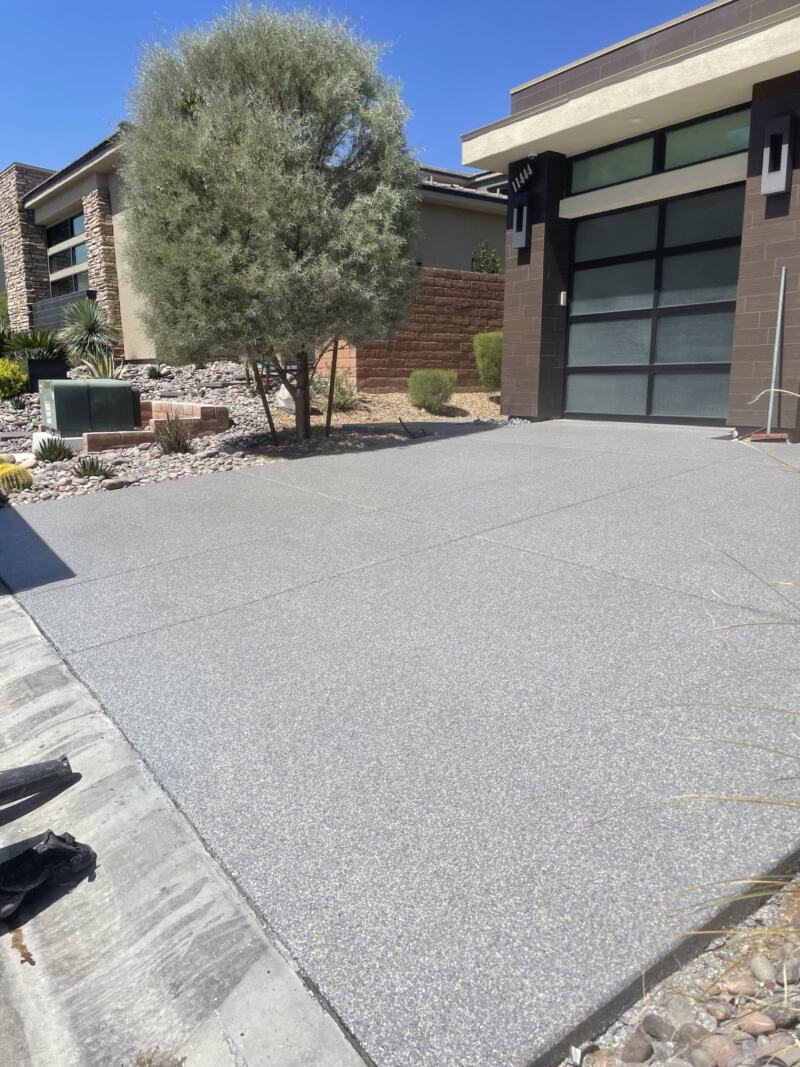
Most of the coatings discussed on this site are rigid. An epoxy or polyaspartic system is a hard film bonded to the slab, and its strength is hardness. Graniflex works on a different principle entirely, and that difference is why it ends up on exterior surfaces where the rigid systems struggle.
Understanding what it is, rather than treating it as another name in the catalog, makes it much easier to see where it belongs.
What the system is
Graniflex is a flexible, polymer-modified cement system built with rubber granules and granite aggregate. It is applied in layers over a prepared slab, then sealed. The finished surface is textured, decorative and considerably more flexible than a resin film.
Several practical properties follow from that construction, and they are the reasons it is specified.
It has some give. A flexible system tolerates slab movement and hairline cracking far better than a rigid film does. In a region where slabs move seasonally and crack, this is the headline feature.
It is thicker than a coating. The build is substantial enough to even out minor surface variation, which is something a thin film cannot do.
It is textured by nature. The aggregate gives traction without a separate additive, which matters around water.
It runs cooler than dark rigid finishes, because of the texture and the color options available, though this is a comparison rather than a promise. The pool deck temperature question is covered in cooler surfaces thanks to pool deck resurfacing.
Where it belongs
Pool decks. This is the strongest case. The combination of flexibility, texture, and cooler surface behavior suits a deck that is wet, walked on barefoot, and sitting over a slab that moves. Related options are on the pool deck coatings page.
Patios. Full sun, thermal cycling, occasional cracking: the same argument applies, and the alternatives are compared in decorative concrete for patios and pool decks.
Driveways. A driveway takes vehicle loads and a lot of sun, and a flexible textured system handles both while covering minor surface damage. The comparison with other driveway finishes is in driveway coating for Las Vegas heat.
Walkways, steps and pool surrounds, where traction matters as much as appearance.
Slabs with cosmetic surface damage that are structurally sound. This is a repair-and-resurface situation, and a thicker flexible system covers more than a thin one.
Where it is the wrong answer
Interior living space. The texture that makes it work outdoors is unpleasant underfoot indoors and difficult to clean. Interior options are covered in interior epoxy concrete floors.
Garage floors, usually. A garage wants a hard, smooth, chemical-resistant surface that cleans easily and takes tire traffic. That is a resin system’s job, as set out on the garage floor coatings page.
Industrial and warehouse floors, where the demands are impact, chemistry and rolling loads. Those are covered in industrial epoxy flooring in Las Vegas.
Structurally failing slabs. Flexibility is not structure. A slab that is settling, heaving or cracking at full depth needs a different conversation, and the criteria are in recoating a failed concrete floor.
The honest trade-offs
Texture holds dirt. The same surface that gives traction collects sand and debris, which in this valley means it collects a lot. Maintenance is washing rather than sweeping, and that is a real difference from a smooth floor.
It is not stain-proof on its own. Its stain resistance comes from the sealer over it, which means the sealer is a maintenance item with a renewal interval rather than a permanent layer. The principle is the same one described in how often to reseal concrete in Las Vegas.
It costs more than a simple sealer or a basic coating. The material is more involved and the application has more steps.
It is a hand-applied finish. Texture and color vary across an installation, which is characteristic of the product rather than a defect. Anyone expecting the uniformity of a sprayed film should see a sample first.
It still needs real surface preparation. Flexibility does not substitute for bond, and the preparation requirements are the same as any system, set out in concrete surface preparation.
Flexibility and cracks, stated precisely
This is the point most often overstated, so it is worth being exact.
A flexible system accommodates minor movement and bridges hairline cracking better than a rigid film. It does not stop a slab from moving, it does not repair a structural crack, and it will not hide a crack with vertical displacement between its two sides.
Existing cracks are still assessed, routed and repaired before anything goes over them, exactly as described in concrete crack repair before coating. What the flexibility buys is better long-term behavior over a slab that continues to move slightly, which in this valley is most slabs.
Sun, which is the other Las Vegas factor
Ultraviolet exposure here is severe, and every exterior coating decision has to account for it.
The sealer over a Graniflex system is the layer taking that exposure, so its ultraviolet performance is what determines whether the color holds. A product chosen for interior use and applied outdoors fades or ambers, which is the mechanism explained in ultraviolet color stability in concrete coatings and ultraviolet resistant epoxy flooring.
Surface temperature is the other consideration. Color value matters more than color choice: a lighter deck is meaningfully cooler than a dark one in the same system, and around a pool that is a comfort and safety decision rather than a style one.
What belongs in the quote
The surface preparation method. Every existing crack, how it was assessed and how it is being repaired. The system build and the number of layers. The color and the texture, confirmed against a physical sample rather than a photograph. The sealer, its ultraviolet rating and its renewal interval. The cure time before the surface can be walked on, furnished and, for a driveway, driven on. And the maintenance regime the texture assumes.
Our decorative and exterior work is on the graniflex coatings and decorative concrete finishes pages.
Frequently asked questions
What is Graniflex and how is it different from epoxy?
It is a flexible, polymer-modified cement system built with rubber granules and granite aggregate, applied in layers and sealed. Epoxy is a rigid resin film whose strength is hardness. Graniflex is thicker, textured by nature, and flexible enough to tolerate the slab movement that cracks a rigid film. That is why it ends up on exterior surfaces rather than in garages.
Will it stop my pool deck from cracking?
No, and no coating does. What a flexible system does is accommodate minor movement and bridge hairline cracking far better than a rigid film. Existing cracks are still assessed, routed and repaired before anything goes over them, and a crack with vertical displacement between its sides is a slab problem rather than a surfacing problem.
Is a Graniflex deck cooler than what I have now?
Usually cooler than a dark, smooth, rigid finish, because of the texture and the color options. The honest version is that color value matters most: a lighter deck in any system is meaningfully cooler than a dark one. If barefoot comfort is the priority, say so when the color is chosen rather than after.
How much maintenance does it need?
Washing rather than sweeping, because the texture that gives traction also collects the valley’s sand and dust. Beyond that, the sealer over it is the layer doing the stain and ultraviolet protection, and it is renewed periodically rather than lasting forever. Both are reasonable, and both are worth knowing before the install rather than discovering afterward.
Can it go on a garage floor?
It can, and it usually should not. A garage wants a hard, smooth, chemical-resistant surface that sweeps clean and handles tire traffic, which is what a resin system provides. The texture that makes Graniflex work on a wet pool deck is a drawback on a garage floor that gets swept and that sees fluid spills.